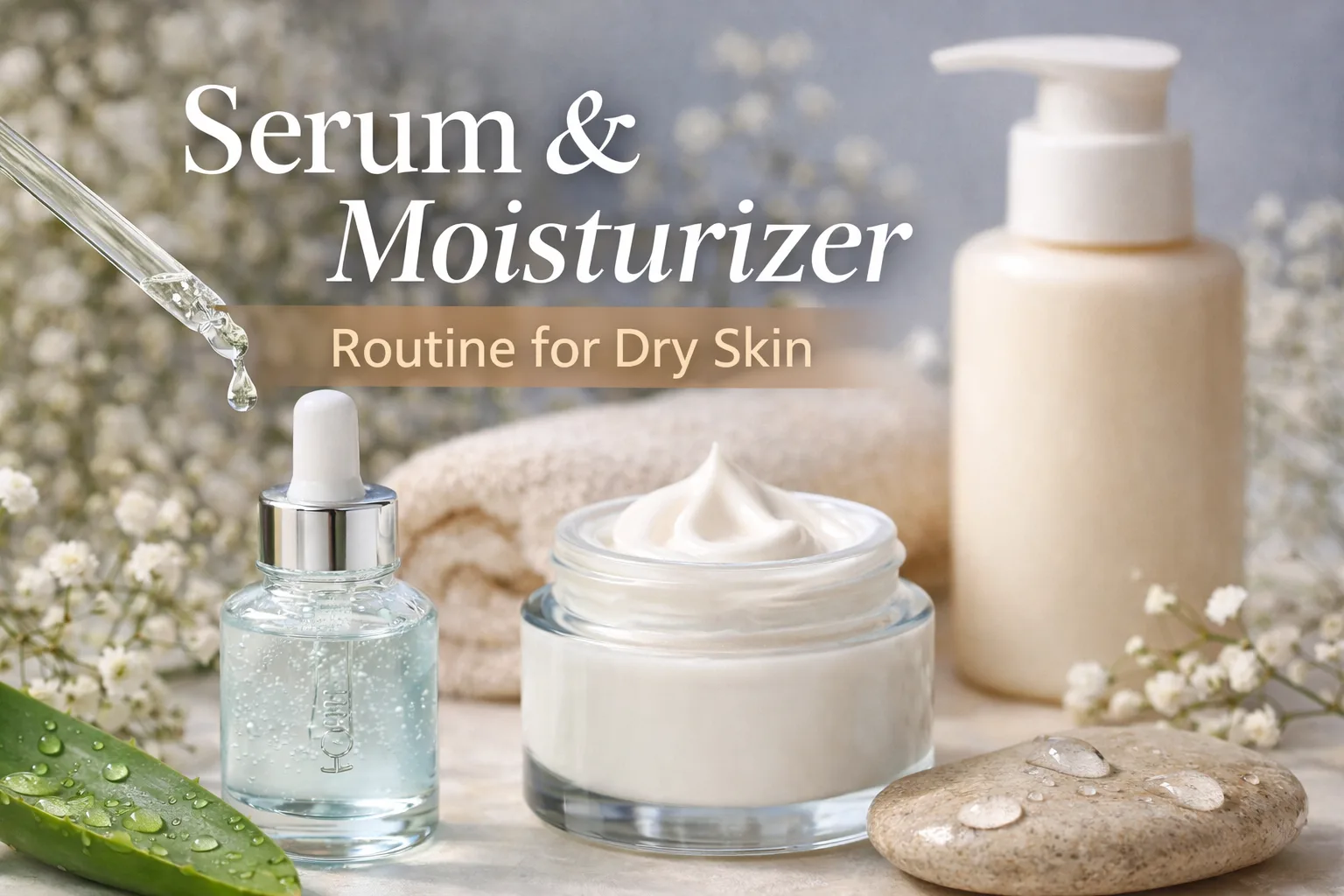
Using a serum and moisturizer for dry skin helps deliver deep hydration while protecting the skin barrier. A hydrating serum penetrates the skin with active ingredients, while a moisturizer seals that hydration in place. Together, they prevent moisture loss, improve texture, and restore a healthy glow.
In this Article
- Understanding the Serum + Moisturizer Routine
- Serum vs Moisturizer: Quick Comparison
- How to Use Serum and Moisturizer for Dry Skin Correctly
- Adjustments Based on Skin Concerns
- Skin Type Guidance
- Recommended Ingredients for Dry Skin
- Budget or Simple Alternatives
- What Dermatologists and Skin Experts Say
- Myth vs Fact
- Frequently Asked Questions
- Expert Takeaway
- Keep The Vibe Going
Understanding the Serum + Moisturizer Routine
What It Is
A serum and moisturizer routine combines two different skincare formulas with distinct roles.
• Serums contain concentrated active ingredients that penetrate deeper into the skin.
• Moisturizers create a protective layer that prevents water loss and strengthens the skin barrier.
Serums treat concerns such as dehydration, pigmentation, or fine lines. Moisturizers maintain hydration and protect the skin from environmental stressors. Together, they form one of the most effective routines for dry skin.
Why It Matters for Skin Health
Dry skin lacks both water and lipids. As a result, the barrier becomes weak and moisture escapes easily. Using only a moisturizer may hydrate the surface temporarily. However, adding a targeted serum increases water-binding capacity and supports deeper hydration. For example, humectants like hyaluronic acid pull water into the skin. Meanwhile, moisturizers containing ceramides or squalane prevent that water from evaporating. This layered approach keeps skin smooth, supple, and resilient.
Serum vs Moisturizer: Quick Comparison
| Feature | Serum | Moisturizer |
| Texture | Lightweight | Creamy or lotion-like |
| Purpose | Target skin concerns | Seal hydration |
| Absorption | Penetrates deeper | Works on surface barrier |
| Key ingredients | Hyaluronic acid, peptides, niacinamide | Ceramides, oils, occlusives |
| Role in routine | Treatment step | Protective step |
For a deeper explanation of this pairing, readers can explore “Serum vs Moisturizer: Do You Really Need Both?” on Hale and Belle.
How to Use Serum and Moisturizer for Dry Skin Correctly
Correct layering determines whether your skincare routine works effectively.
Step-by-Step Routine
- Cleanse gently
Choose a mild hydrating cleanser that cleans without removing essential oils. - Apply toner or mist (optional)
This adds a light layer of hydration and improves absorption. - Apply serum on slightly damp skin
Use two to three drops and press gently into the skin. - Wait 30–60 seconds
Allow the serum to absorb before applying the next layer. - Seal with moisturizer
Choose a rich cream or barrier-repair moisturizer. - Finish with sunscreen in the morning
Layering products from lightest to heaviest improves penetration and prevents pilling. A detailed ingredient layering guide is explained in “Skincare Ingredients Layering for Better Absorption.” Skincare Ingredients Layering for Better Absorption
Adjustments Based on Skin Concerns
Dry skin rarely appears alone. Many people also experience other concerns.
Adjust the serum accordingly:
• Fine lines: peptides or retinol serums
• Pigmentation: vitamin C or niacinamide
• Extreme dehydration: hyaluronic acid or glycerin
• Barrier damage: ceramides or panthenol
For example, improper use of hyaluronic acid can sometimes worsen dryness. Hale and Belle explains this in “Hyaluronic Acid Serum Issues: Why It’s Not Working & How to Fix It.” Hyaluronic Acid Serum Issues: Why It’s Not Working & How to Fix It
Skin Type Guidance
Even though this routine benefits dry skin most, every skin type can adapt it differently.
Oily Skin
Oily skin still requires hydration.
Use:
• lightweight hydrating serums
• gel moisturizers
• non-comedogenic formulas
Niacinamide-based serums often balance oil production while maintaining hydration.
Dry Skin
Dry skin benefits most from layered hydration.
Ideal combinations include:
• hyaluronic acid serum + ceramide cream
• glycerin serum + squalane moisturizer
• peptide serum + barrier repair cream
A detailed ingredient breakdown appears in “Dry Skin Guide: Causes, Symptoms, and Best Serums.”
Sensitive Skin
Sensitive skin requires minimal, soothing formulas.
Look for:
• fragrance-free serums
• calming ingredients like centella asiatica
• barrier-repair moisturizers
Always introduce actives slowly.
Acne-Prone Skin
Acne-prone skin often avoids moisturizers. However, skipping them can worsen dehydration.
Instead:
• use lightweight serums with niacinamide
• choose oil-free moisturizers
• avoid heavy occlusives
An example of acne-friendly serums appears in Hale and Belle’s review of The Derma Co Niacinamide Serum.
Recommended Ingredients for Dry Skin
Instead of focusing on individual products, dermatologists recommend choosing ingredients that work synergistically.
Hydrating Serums
Look for:
• Hyaluronic acid – attracts moisture
• Glycerin – improves hydration retention
• Panthenol – soothes and repairs
• Peptides – support collagen
Barrier-Repair Moisturizers
Effective moisturizers often include:
• Ceramides – restore the skin barrier
• Squalane – prevents moisture loss
• Shea butter – deeply nourishes
• Fatty acids – reinforce lipid structure
Together, these ingredients restore the moisture balance that dry skin lacks.
Budget or Simple Alternatives
Skincare does not always require expensive products.
Simple hydration solutions include:
• hyaluronic acid serum paired with a basic ceramide cream
• Apply aloe vera gel first, followed by a rich moisturizer.
• squalane oil mixed into moisturizer for extra nourishment
What Dermatologists and Skin Experts Say
Dermatologists often describe skincare hydration using three categories:
Humectants, emollients, and occlusives.
• Humectants (hyaluronic acid, glycerin) attract water into the skin.
• Emollients (squalane, fatty acids) soften and smooth the surface.
• Occlusives (petrolatum, shea butter) prevent water loss.
Serums usually deliver humectants. Moisturizers combine emollients and occlusives. When layered together, they recreate the skin’s natural moisture system.
Dermatologist Insight
Dr. Cho Seung Jun, Dermatolgist at Reberry Clinic, explains:
Dry skin is a barrier issue, not just a surface issue with a lack of moisture. The outer layer (stratum corneum) is not holding onto moisture like it should be, which is why using a hydrating serum under your moisturizer can make a huge difference. The skin-science behind this is quite simple. Serums have an incredibly light, water-based formula that absorbs quickly into the skin while delivering active humectants, such as hyaluronic acid and glycerin which draw moisture into the cells of the skin. In contrast, moisturizers provide a barrier to keep the moisture within the skin by being occlusive (preventing moisture from passing through) and emollient (softening the outer layer). Therefore, if you skip the serum and go straight to the moisturizer, you are only locking in the existing moisture on your skin. By layering the serum underneath the moisturizer, you can first super-hydrate your skin, and then lock-in that moisture with the moisturizer.
For my patients who have dry skin , I tell to look for serums with hyaluronic acid and glycerin as the base humectants, then follow with a moisturizer that contains ceramides. Ceramides are lipids that naturally exist in your skin barrier, replenishing them topically helps restore barrier integrity over time, not just temporarily hydrate.
The most common mistake I see? Applying serum to completely dry skin and then waiting too long before moisturizing. Humectants work best applied to slightly damp skin, right after cleansing, and you want to follow immediately with your moisturizer while the skin is still a little tacky. Waiting lets that moisture evaporate before you’ve had a chance to seal it in, which defeats the purpose entirely.
Another mistake includes using a serum with a heavy fragrance or alcohol base, which can further compromise a dry or sensitive barrier.
Patiens need to keep the routine simple with a good humectant serum, a ceramide-rich moisturizer, and consistent application which is more effective than layering multiple products that work against each other.
Ingredient Insight
Ceramides are particularly important. These lipids make up nearly 50% of the skin barrier. When levels decline, dryness, irritation, and fine lines appear. Adding ceramide-rich moisturizers restores barrier strength and reduces transepidermal water loss.
Dermatologist Advice
Skin experts often recommend:
• applying hydrating serums to damp skin
• sealing hydration within one minute
• avoiding over-exfoliation for dry skin
Consistency matters more than complexity. Even a simple three-step routine can restore healthy hydration.
Myth vs Fact
Myth: Moisturizer alone can hydrate dry skin completely.
Fact: Moisturizers seal hydration but rarely provide enough water-binding ingredients alone. A hydrating serum significantly improves results.
Frequently Asked Questions
Yes. Serums deliver hydration and active ingredients deeper into the skin, while moisturizers lock that hydration in and protect the skin barrier.
No. Moisturizers primarily protect the skin barrier, while serums deliver concentrated active ingredients that treat specific skin concerns.
Hydration may evaporate quickly. This can lead to tightness, dryness, and irritation.
Apply serum first on slightly damp skin. After it absorbs, follow with a moisturizer to seal in hydration.
People with extremely sensitive or compromised skin should avoid strong actives like retinol or high-strength acids until their barrier heals.
Expert Takeaway
A serum and moisturizer for dry skin routine remains one of the simplest yet most effective skincare strategies. Hydrating serums deliver active ingredients deep into the skin. Moisturizers then lock that hydration in place while strengthening the skin barrier. Choose ingredients wisely, layer products correctly, and maintain consistency. Over time, this approach restores hydration, smoothness, and long-lasting glow.
Want the latest scoop, exclusive deals, and skincare secrets? Follow us on WhatsApp and never miss a glow-up moment!