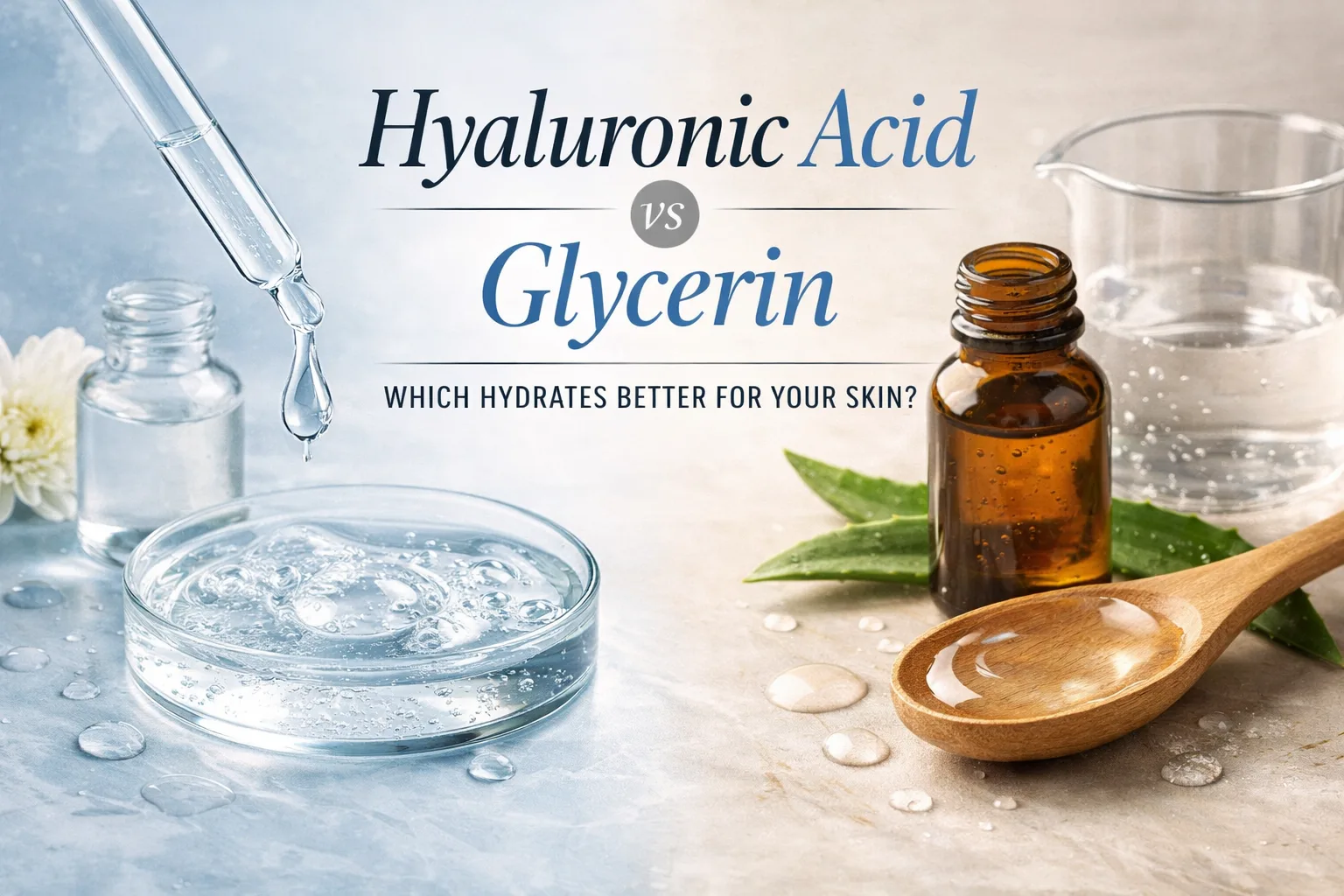
When comparing hyaluronic acid vs glycerin, both hydrate the skin effectively, but in different ways. Hyaluronic acid delivers instant plumping by binding water to the surface, while glycerin provides deeper, longer-lasting hydration by strengthening the skin barrier. The best choice depends on your skin type, routine, and environment.
In this Article
- Hyaluronic Acid vs Glycerin: What’s the Real Difference?
- Hyaluronic Acid vs Glycerin: Side-by-Side Comparison
- Which Hydrates Better: Hyaluronic Acid or Glycerin?
- How Hyaluronic Acid Works to Hydrate and Plump Skin
- Why Glycerin Delivers Deeper, Long-Lasting Hydration
- How to Layer Hyaluronic Acid and Glycerin Correctly
- Best Choice for Your Skin Type
- When Hyaluronic Acid Can Actually Dry Your Skin
- Best Ingredient Pairings for Maximum Hydration and Glow
- Hyaluronic Acid vs Glycerin in Indian Climate: What Works Best
- What Dermatologists and Skin Experts Say
- Frequently Asked Questions
- Expert Takeaway
- Keep The Vibe Going
Hyaluronic Acid vs Glycerin: What’s the Real Difference?
Both hyaluronic acid and glycerin belong to a group of skincare ingredients known as humectants, which attract water into the skin. If you’re exploring how different ingredients support hydration and skin health, our skincare ingredients guide explains how humectants, emollients, and occlusives work together in a routine.
What is Hyaluronic Acid?
Hyaluronic acid is a compound naturally found in the skin. It holds water and gives skin a plump, smooth appearance.
- Works on the upper layers of skin
- Provides instant hydration and glow
- Reduces the appearance of fine lines
What is Glycerin?
Glycerin is a plant-derived humectant known for its stability and effectiveness.
- Penetrates deeper into the skin
- Improves long-term hydration
- Strengthens the skin barrier
Why This Difference Matters
Hydration is not just about adding water. It is about retaining it and preventing moisture loss. This is why humectants play an important role in the hydration step in routine, helping the skin attract and hold water effectively. In many cases, glycerin performs more consistently than hyaluronic acid.
Hyaluronic Acid vs Glycerin: Side-by-Side Comparison
| Feature | Hyaluronic Acid | Glycerin |
| Hydration type | Surface + plumping | Deep + sustained |
| Skin penetration | Limited | Deeper layers |
| Best result | Instant glow | Long-term hydration |
| Climate sensitivity | High | Low |
| Barrier support | Moderate | Strong |
Which Hydrates Better: Hyaluronic Acid or Glycerin?
The answer depends on context.
- For instant hydration: Hyaluronic acid wins
- For long-lasting hydration: Glycerin is more reliable
- For overall skin health: Using both is ideal
The Key Insight
Hyaluronic acid pulls water into the skin.
Glycerin helps keep it there.
Without proper sealing, hyaluronic acid can even lead to dehydration in dry environments.
How Hyaluronic Acid Works to Hydrate and Plump Skin
Hyaluronic acid acts like a sponge. It binds water and expands, creating a plumping effect.
However, its performance depends on:
- Environmental humidity
- Proper application (damp skin)
- Sealing with a moisturizer
When It Works Best
- Humid climates
- Layered under creams
- In multi-weight formulations
Why Glycerin Delivers Deeper, Long-Lasting Hydration
Glycerin penetrates the stratum corneum, the outermost skin layer. It improves water balance and reduces transepidermal water loss (TEWL), which helps repair skin barrier function and keep moisture locked in.
This leads to:
- Stronger skin barrier
- Reduced dryness and irritation
- More consistent hydration
Why Dermatologists Prefer It
Glycerin is stable, non-irritating, and effective across all climates.
How to Layer Hyaluronic Acid and Glycerin Correctly
Knowing how to layer hydration ingredients correctly can make a noticeable difference in results. If you’re learning how to build your skincare routine, understanding how serums work will help you place lightweight humectants like hyaluronic acid before thicker moisturizers that contain glycerin, maximizing hydration and supporting your skin barrier.
Step-by-Step Routine
- Cleanse your skin gently
- Apply hyaluronic acid on damp skin
- Follow with a glycerin-based moisturizer
- Seal with sunscreen (morning) or cream (night)
Pro Tip
Always apply humectants on slightly damp skin. This improves hydration performance significantly.
Best Choice for Your Skin Type
Before deciding between hyaluronic acid and glycerin, it helps to identify your skin type, since different skin types respond to hydration ingredients in different ways.
Oily Skin
Oily skin still needs hydration, and lightweight humectants like hyaluronic acid and glycerin can help maintain moisture without adding excess oil.
- Use lightweight hyaluronic acid
- Add minimal glycerin for balance
Dry Skin
If your skin often feels tight or flaky, exploring targeted solutions for dry skin can help you choose the right hydrating ingredients and routines.
- Prioritize glycerin-rich moisturizers
- Layer hyaluronic acid underneath
- Seal hydration with barrier-supporting creams
Sensitive Skin
Sensitive skin benefits from gentle hydration, and both hyaluronic acid and glycerin can help soothe dryness while supporting the skin barrier.
- Focus on glycerin for barrier repair
- Use hyaluronic acid cautiously
Acne-Prone Skin
Many people with breakouts skip moisturizers, but proper hydration for acne skin is essential to keep the barrier balanced and prevent excess oil production.
- Both are safe and non-comedogenic
- Help counter dryness from actives
- Hydration can reduce irritation from actives like retinoids and benzoyl peroxide
When Hyaluronic Acid Can Actually Dry Your Skin
This is one of the most misunderstood aspect.
Hyaluronic acid can backfire when:
- Applied on dry skin
- Used without moisturizer
- Used in low-humidity environments
What Happens
Instead of pulling moisture from the air, it pulls it from your skin, leading to dehydration.
Best Ingredient Pairings for Maximum Hydration and Glow
Choosing formulas that combine humectants with barrier-supporting ingredients can make a noticeable difference. If you’re exploring the best hydrating products, look for formulas that pair glycerin or hyaluronic acid with complementary ingredients.
- Hyaluronic acid + niacinamide: hydration + oil control
- Glycerin + ceramides: barrier repair
- Hyaluronic acid + panthenol: soothing hydration
- Glycerin + occlusives: long-lasting moisture lock
Hyaluronic Acid vs Glycerin in Indian Climate: What Works Best
Climate plays a major role.
Humid Weather
- Hyaluronic acid performs well
- Enhances glow and plumpness
Dry Weather or AC Environments
- Glycerin is more reliable
- Prevents moisture loss
Best Approach
Use both for balanced hydration throughout the year.
What Dermatologists and Skin Experts Say
Dermatologically, both ingredients function as humectants, but their mechanisms differ.
Hyaluronic acid primarily sits in the upper skin layers. It binds water and creates a temporary plumping effect. This reduces the appearance of fine lines.
Glycerin penetrates deeper into the stratum corneum. It improves water content and reinforces lipid structure. This strengthens the skin barrier over time.
Experts often recommend combining both. This dual approach ensures immediate and long-term hydration.
Key insight: Hydration is not just about attracting water. It is about retaining it.
Myth vs Fact
Expert Insight
Healthy skin requires:
- Humectants (like HA and glycerin)
- Emollients (to soften)
- Occlusives (to seal moisture)
Myth vs Fact
Myth: Hyaluronic acid is the best hydrator.
Fact: Glycerin often provides more consistent hydration in real-world conditions.
Frequently Asked Questions
No, but using both provides better hydration results.
Yes, especially for long-term hydration and barrier repair.
Apply hyaluronic acid first, then glycerin-based moisturizer.
No. It must be sealed with a moisturizer to prevent dehydration.
Hyaluronic acid gives instant glow, while glycerin improves skin health over time.
Expert Takeaway
When comparing hyaluronic acid vs glycerin, the most effective approach is using both strategically within a well-balanced routine. Hyaluronic acid delivers instant hydration and plumping, while glycerin helps maintain long-lasting moisture and barrier support. For more expert skincare tips and guides, explore our in-depth resources designed to help you build a routine that keeps your skin healthy and glowing.
Key points to remember:
- Hyaluronic acid delivers instant hydration and plumpness
- Glycerin ensures lasting hydration and barrier strength
- Together, they create a complete hydration system
If your goal is healthy, glowing skin, use both strategically and consistently.
Want the latest scoop, exclusive deals, and skincare secrets? Follow us on WhatsApp and never miss a glow-up moment!