You’ve Been Getting Facials Wrong — And So Has the Industry
Here’s an uncomfortable truth the beauty industry rarely says out loud: most facials don’t work. Not because the ingredients are ineffective. Not because the techniques are wrong. But because they begin at the wrong point entirely — and AI skin analysis is exposing exactly why.
For decades, the beauty industry has treated the facial as skincare’s gold standard — a monthly ritual promising clearer pores, brighter skin, and a skin tone reset. Clinics fill their menus with hydrating facials, brightening facials, anti-aging facials. Clients pick one, sit back, and hope for the best.
That hope is the problem.
What happens in the treatment room largely follows what the therapist sees on the surface — a trained eye, a client’s self-reported concerns, and a protocol designed for a demographic, not a person. The result? Treatments that feel luxurious in the moment but fail to deliver lasting biological change. And for many skin types, they quietly make things worse.
The missing step isn’t a serum. It isn’t a device. It’s a diagnosis.
Why Most Facials Fail to Deliver Real Results
The Guesswork Problem
When you walk into most clinics today, you answer a brief intake form. Sensitive? Oily? Prone to breakouts? Based on your answers — and perhaps a cursory visual assessment under a magnifying lamp — a therapist selects a protocol from a pre-set menu.
This approach carries a fundamental flaw: it treats skin as a category, not a system. Human skin is a dynamic, layered organ with invisible biological activity happening far beneath what any eye can detect. Inflammation, barrier dysfunction, accelerated collagen degradation, and abnormal pigmentation pathways can all remain entirely invisible at the surface level — and yet they are the very forces dictating what your skin needs.
Choosing a treatment without understanding these dynamics isn’t professional skincare. It’s an educated guess dressed up in a white coat.
One-Size-Fits-All Is a Design Failure
The standard facial model was built for efficiency, not precision. Product lines target broad skin categories — dry, oily, combination, sensitive — and clinics build their protocols around these same blunt categories.
Consider this: two clients both present with dull, uneven skin tone. One has subclinical inflammation driving reactive pigmentation; the other has impaired barrier function causing chronic dehydration that manifests as dullness. These are biologically distinct conditions. They require biologically distinct interventions.
Apply the same brightening facial to both, and you’ve helped one and potentially aggravated the other. Barrier-compromised skin treated with actives it cannot tolerate doesn’t bounce back — it regresses. And the client, unaware of the underlying mechanism, simply books another facial next month.
Surface Treatment, Subsurface Damage
The most overlooked issue in aesthetic skincare is the gap between what looks good and what is biologically improving.
Transepidermal water loss (TEWL) — the rate at which water evaporates through the skin — is one of the most reliable indicators of barrier health. Elevated TEWL signals a compromised skin barrier, one that neither retains moisture nor protects against environmental aggressors. A facial that temporarily plumps and hydrates with no regard for barrier repair might suppress the visible signs while leaving the underlying dysfunction untouched.
Similarly, subclinical inflammation — low-grade, below-the-surface irritation that doesn’t present as obvious redness — can worsen chronically through aggressive exfoliation, ill-matched enzyme treatments, or even the wrong massage technique on a sensitised vasculature. Over time, this silent inflammation drives collagen degradation and accelerates skin aging.
Skincare that ignores this does more than underperform. It intervenes in a system it hasn’t assessed.
The Missing Step: Skin Diagnosis Before Skin Treatment
A Paradigm Shift, Not a Feature
The question the industry should have always asked is simple: why do we treat before we diagnose?
In medicine, this would constitute negligence. A cardiologist doesn’t prescribe treatment based on how a patient looks. A dermatologist doesn’t recommend prescription-strength actives without first understanding the skin’s biological state. Yet in the aesthetic clinic, treatment-first remains the default.
Skin diagnostics — the systematic assessment of the skin’s measurable biological parameters before any treatment begins — represents a fundamental philosophical shift. Not an upgrade. Not an add-on. A completely different entry point into skincare.
This is where AI skin analysis changes everything.
Advanced AI skin analysis technology assesses the skin across multiple parameters simultaneously — from moisture levels and sebum distribution to pigmentation concentration, pore density, wrinkle depth, and UV damage invisible to the naked eye. What the human eye misses in seconds, a calibrated diagnostic system captures with precision.
This isn’t cosmetic technology. It’s clinical methodology applied to aesthetic care.
What Really Happens Beneath the Surface
Barrier Damage
The skin barrier — primarily the stratum corneum — is the body’s first line of defence. When it falters, the skin loses water faster than it can retain it, reacts to ingredients it would otherwise tolerate, and loses its capacity to support any active treatment effectively. Understanding this property, as the skincare routine basics demand, isn’t optional — it’s foundational.
Many clients presenting with “sensitive skin” are actually experiencing a chronically damaged barrier. Treating this with stimulating facial treatments, regardless of how well-intentioned, is biochemically counterproductive.
The Cellular Foundation Most Facials Never Build
Here is what the conventional facial industry consistently skips — and what makes its results so short-lived.
Before any treatment can deliver lasting change, the skin needs three things to be functioning at a cellular level: active prevention of water loss, sustained hydration retention, and protection of its natural lipid barrier against oxidative stress and lipid peroxidation.
Lipid peroxidation — the breakdown of the skin’s fatty acid layer caused by free radical damage — is one of the most underdiagnosed drivers of skin vulnerability. When the skin’s lipid barrier breaks down, it loses its ability to protect itself against environmental aggressors, retain moisture, and tolerate active ingredients. Every treatment applied on top of this compromised foundation is essentially building on unstable ground.
This is the cellular reality most facials never address. Glow, brightening, lifting — these are aspirational outcomes. But they are only achievable when the skin’s microbiome is balanced, its water loss is controlled, and its lipid integrity is intact. Skip these steps, and every treatment becomes a temporary fix on a permanently unstable base.
Subclinical Inflammation and Pigmentation Pathways
Inflammation is the skin’s most misunderstood condition. By the time it becomes visible, it has often been present — and compounding — for weeks. Subclinical inflammation activates melanocyte-stimulating pathways, contributing to post-inflammatory hyperpigmentation (PIH) that even the most carefully targeted brightening actives struggle to reverse once established.
Diagnosing inflammation before treatment allows the clinician to select anti-inflammatory protocols first, creating the right biological environment for brightening or corrective work to actually function. This sequencing isn’t a preference — it’s a prerequisite.
Collagen Degradation and Invisible Aging
UV-induced collagen degradation — quantifiable through sub-surface imaging — often appears years before fine lines and volume loss become visible. Addressing it reactively, with retinol in anti-aging routines or peptide treatments initiated only after signs emerge, manages aging rather than preventing it.
Early-stage diagnostic data allows clinicians to intervene at the biological timeline that actually matters. That’s the difference between reactive skincare and strategic skincare.
Research published in the Journal of Investigative Dermatology confirms that UV-induced changes to the dermal matrix begin long before surface signs emerge — underscoring precisely why visual assessment alone falls short as a clinical baseline.
From Guesswork to Precision Skincare
When Data Drives Decisions
Personalised skincare isn’t a marketing term. In its truest form, it anchors every treatment decision to the individual’s measurable skin biology — not their skin type category, not their age, and not what worked for the client before them.
Diagnostic-led skincare removes assumption from clinical decision-making. It replaces the aesthetic therapist’s instinct — valuable as it is — with a layered understanding of what the skin actually needs at the cellular level. It also creates a baseline from which clinicians can objectively measure all future progress.
For clinicians, this is transformative. For clients, it means finally understanding why their skin responds the way it does — and what to actually do about it.
Ingredients like hyaluronic acid for hydration genuinely deliver results, but only within the right clinical context. Layering a hyaluronic acid treatment over a severely compromised barrier can paradoxically worsen dehydration if the moisture it draws in escapes through those same damaged pathways. Diagnostics make these distinctions visible before treatment begins.
Inside a Modern Skin Consultation: Step by Step
The architecture of a diagnostic-led consultation looks fundamentally different from a conventional facial booking. Here’s what precision skincare looks like in practice:
- Skin Scan A multi-spectral AI imaging system photographs the skin under various light wavelengths, capturing both surface and sub-surface data across pigmentation, hydration, sebum, UV damage, texture, pores, and vascular conditions.
- AI Analysis The system generates a detailed diagnostic profile — not a “skin type” — mapping the skin’s specific biological state with clinical precision.
- Expert Consultation A trained skin specialist reviews the diagnostic data alongside the client’s history, lifestyle, concerns, and goals. This is not a product recommendation conversation. It is a clinical discussion grounded in data.
- Personalised Treatment Plan Based on the diagnosis, the clinician designs a sequenced treatment plan. Not a menu selection — a protocol matched to the skin’s current biology and its trajectory.
- Progress Tracking Subsequent scans enable objective before-and-after comparisons, removing subjectivity from outcome assessment and allowing ongoing protocol refinement.
This model treats the skin as what it is: a dynamic biological system that requires ongoing, evidence-based management — not seasonal pampering.
Expert Insight: Diagnosis First, Treatment Second
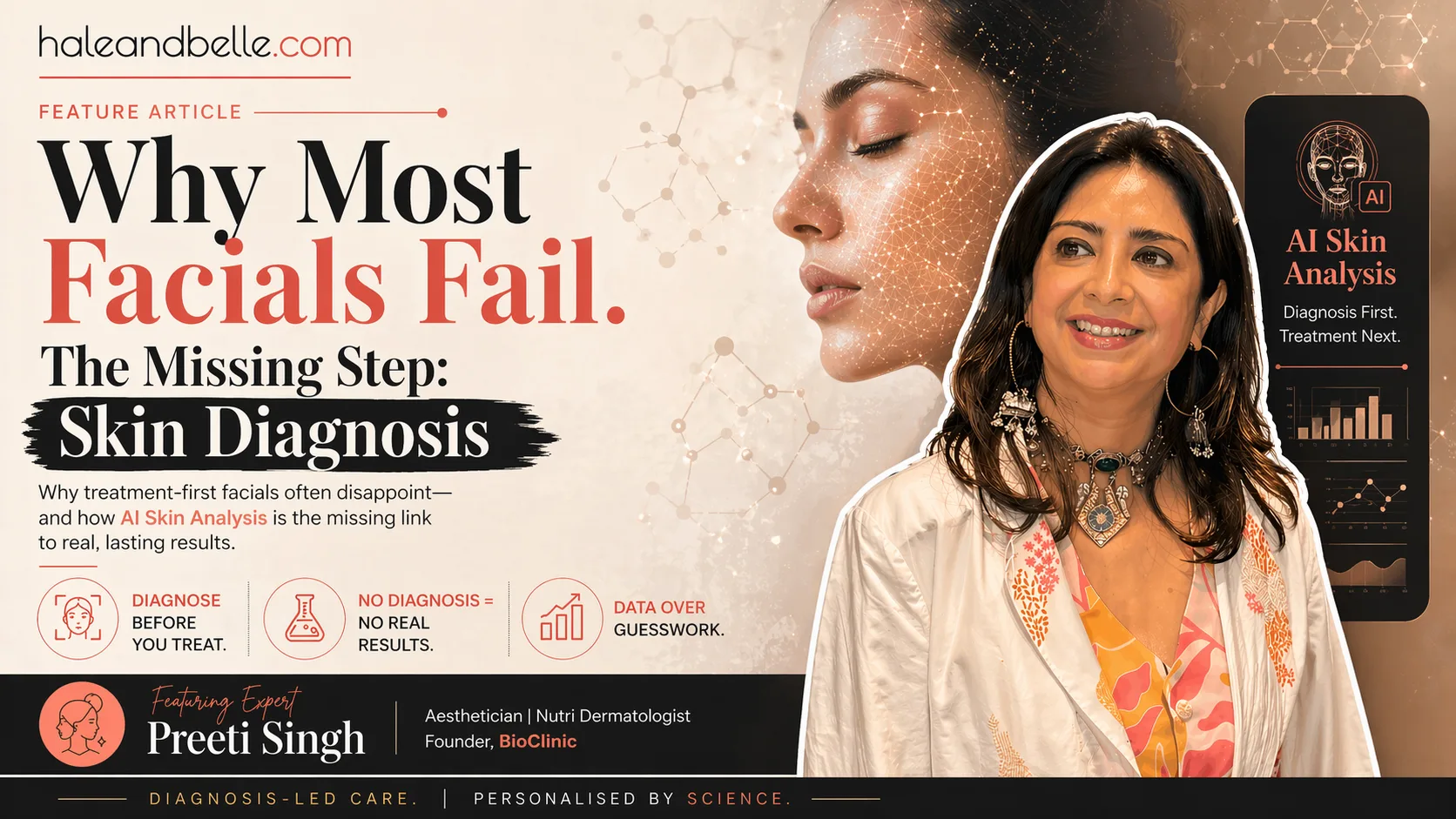
Preitti Singh, Founder of BioClinic, has spent years watching clients arrive carrying the cumulative weight of treatments that never reached the real problem.
“At BioClinic, we treat the root cause. We work to create skin fitness over a few targeted sittings that operate at deep cellular levels — changing how the skin actually behaves — rather than addressing the superficial aspirations of a facial: glow, tan removal, lifting. These outcomes are achievable, but only after you build the skin first. The only truth in skincare is that you must establish a healthy microbiome, prevent transepidermal water loss, maintain hydration, and protect the skin’s lipid integrity against oxidative stress and peroxidation. Until you secure all three at a cellular level, every treatment you apply is working on an unstable foundation.” — Preitti Singh, Founder, BioClinic
This is the clinical distinction that separates diagnostic skincare from conventional facials. Singh is clear that even BioClinic offers instant-gratification treatments — a party facial for a client who wants immediate results. But she draws a sharp line between that and the clinic’s deeper aesthetic protocols, which begin with a full cellular assessment before a single active is applied.
Her AI scan findings reinforce this. The diagnostic data consistently reveals one finding that changes every treatment decision that follows: moisture levels are the single most accurate predictor of how much the skin can tolerate.
“The real story lies beneath the skin. Most skincare fails not because of bad products or bad technique — but because no one stopped to read that story first.” — Preitti Singh, Founder, BioClinic“When BioClinic maps and scans the skin, we measure moisture levels with precision — and that measurement is directly proportionate to how much brightening the skin can handle. The lower the moisture, the higher the chances of a reaction. This is why building skin health first and then transcending to brighter, healthier skin is the only right way forward. You cannot chase brightness on a dehydrated, compromised skin — you will always lose.” — Preitti Singh, Founder, BioClinic
This insight reframes the brightening conversation entirely. Chasing glow on moisture-depleted skin doesn’t just fail — it actively damages. The skin reacts, the barrier weakens further, and the client interprets the reaction as sensitivity rather than what it actually is: a treatment applied to skin that was never ready for it.
The Future of Skincare Is Already Here
AI in beauty is no longer speculative. It is here, it is measurable, and it is rapidly becoming the standard against which all other skincare models will be judged.
Global investment in AI-driven skin diagnostics and personalised skincare has accelerated sharply over the past five years. Technology platforms that once existed only in clinical research contexts now integrate into aesthetic practices — not as novelty features, but as clinical infrastructure.
The direction of travel is clear: skincare is moving from generalised to individualised, from assumption-led to data-driven, from reactive to predictive. Clients who see the most meaningful, lasting results in the next decade will be those whose skincare is anchored in biological understanding, not product selection.
The clinics that lead will be those that already treat diagnosis as the beginning — not the afterthought.
Takeaway: Skincare Begins Before the First Product Is Applied
If there is a single principle the next era of skincare must absorb, it is this: understanding must precede application.
The facial is not the problem. The product is not the problem. The problem is the absence of the diagnostic moment — the step where the skin speaks and the clinician listens, before anything touches, removes, or stimulates it.
Glow, brightness, and lifted skin are not unrealistic aspirations. But they are outcomes, not starting points. Reach for them on a skin that hasn’t been built from the cellular level up — one whose water loss is uncontrolled, whose lipid barrier is compromised, whose microbiome is disrupted — and you will keep arriving at the same place: temporary results, lasting frustration.
A truly effective skincare outcome isn’t built in the treatment room. It takes shape in the consultation — in the data, the analysis, and the clinical plan that precedes every decision. Precision skincare doesn’t begin when the mask goes on. It begins when someone finally asks the right question about your skin.
The industry is catching up. The question is whether your skincare already has.
Frequently Asked Questions
A1: AI skin analysis uses multi-spectral imaging technology to capture detailed data about the skin’s surface and sub-surface conditions — including hydration levels, pigmentation, UV damage, sebum distribution, and barrier health. The system processes this data to generate a clinical diagnostic profile, identifying issues that the naked eye cannot detect. This forms the biological baseline for all subsequent treatment decisions.
A2: Most facials fail because they rely on visual assessment and generalised protocols rather than skin diagnostics. Without understanding the skin’s biological state — including TEWL levels, barrier function, and subclinical inflammation — treatments cannot match actual needs. The result is surface-level improvement without meaningful biological change.
A3: A standard consultation relies on visual assessment and self-reported concerns. Skin diagnostics uses technology to evaluate measurable biological skin parameters — delivering clinical precision over aesthetic opinion. The result forms the foundation of truly personalised skincare.
AI skin analysis detects a wide range of visible and sub-visible skin conditions, including UV damage, pigmentation irregularities, dehydration, compromised barrier function, enlarged pores, fine lines, sebum imbalances, and vascular changes. Importantly, it identifies conditions in their early stages — before they become clinically visible — enabling earlier, more effective intervention.
A5: No. Personalised skincare — grounded in diagnostic data — benefits every skin type and concern level. Even skin that appears healthy can carry sub-surface issues that, when identified early, clinicians can address before they manifest visibly. Diagnostic-led skincare works equally well as a preventive strategy as it does a corrective one.
Want the latest scoop, exclusive deals, and skincare secrets? Follow us on WhatsApp and never miss a glow-up moment!
Hale and Belle is committed to editorial integrity and dermatology-informed beauty reporting. This article was produced in partnership with BioClinic.