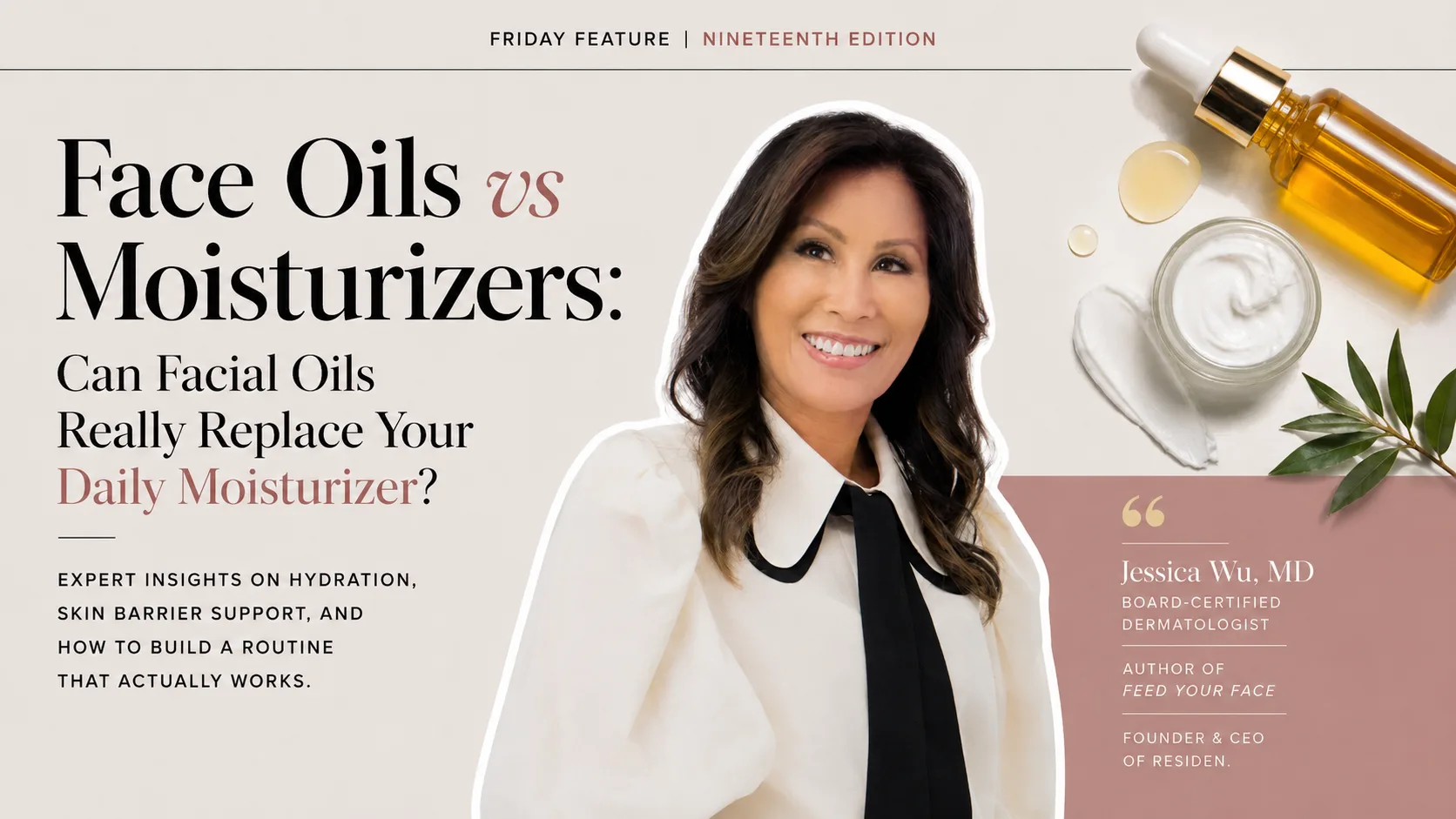
Friday Feature — Nineteenth Edition Featuring Dr. Jessica Wu – MD, Board-Certified Dermatologist | Founder & CEO, Residen | 20+ Years Clinical Practice, Los Angeles
The skincare debate dominating your algorithm — answered with science.
Face oils are everywhere right now. They sit on vanity shelves between serums and mists, they close out ten-step routines, and on Instagram Reels, they catch the light in that specific dewy way that makes half a million people add them to their carts before breakfast. Yet somewhere between the glass-skin tutorials and the oil-cleansing threads, a question keeps surfacing: can face oils replace moisturizer — or is that just wishful minimalism?
It’s a reasonable thing to wonder. Oils feel rich, they absorb beautifully, and the marketing around them often leans hard into words like “nourishing,” “hydrating,” and “barrier-restoring.” But dermatologists are consistent in drawing a clear line here — and understanding that line could change how your entire routine performs.
The short answer is: for most people, no. Face oils are not a direct replacement for moisturizer. The longer answer is more interesting — and far more useful.
What Facial Oils Actually Do for the Skin
A face oil is, at its simplest, a lipid. It belongs to the emollient category of skincare — a group of ingredients that work by filling in the microscopic gaps between skin cells, smoothing the surface, and improving suppleness. Emollients don’t deliver water to the skin. Instead, they make the skin feel soft and look luminous by reinforcing the texture of the outermost layer, the stratum corneum.
Most botanical oils — rosehip, squalane, jojoba, marula, sea buckthorn — are rich in fatty acids, including linoleic acid and oleic acid. These fatty acids are structurally similar to the lipids naturally found in healthy skin, which is why a well-chosen oil can strengthen the skin’s protective architecture rather than merely sit on top of it. Some oils also carry antioxidants, plant sterols, and anti-inflammatory compounds that add functional value beyond basic lubrication.
“My 20+ years as an L.A. dermatologist show that oils primarily act as emollients, enhancing suppleness and sealing the skin barrier.”
Dr. Jessica Wu, Founder & CEO, Residen
Beyond emollience, many oils also offer a light occlusive effect — they slow the rate at which water evaporates from the skin’s surface. This is known as reducing transepidermal water loss, or TEWL. If you’ve read our guide on occlusive ingredients and how they work, you’ll know that TEWL is one of the key mechanisms behind chronic dehydration and barrier weakness. Oils address this — but only partially.
How Moisturizers Work Differently
A moisturizer is a multi-functional formulation. Most well-designed creams and lotions contain three categories of ingredients working in concert: humectants, emollients, and occlusives. Humectants — think hyaluronic acid, glycerin, and panthenol — actively attract and bind water molecules to the skin. Emollients smooth and soften. Occlusives create a physical barrier that slows moisture escape.
Together, these three mechanisms tackle skin hydration from multiple angles simultaneously. A moisturizer doesn’t just make your skin feel better in the moment; it actively manages the moisture cycle. This is why, even if an oil dramatically improves how your skin looks and feels, it cannot replicate what a well-formulated moisturizer does for water retention and cellular hydration.
As Dr. Wu explains, “Moisturizers typically offer a broader spectrum of ingredients, including water-soluble components for comprehensive hydration and repair.” That word — water-soluble — is the crux of the issue. Oils, by their nature, are lipid-based. They cannot carry water-soluble actives like hyaluronic acid or ceramide precursors. Those ingredients require an aqueous base — and that’s precisely what most moisturizers provide.
For a deeper comparison of layering logic, our breakdown of serums vs moisturizers explains how each format targets different layers of the skin — and why both still serve a purpose even in an oil-forward routine.
What’s the Difference Between Hydration and Moisture in Skincare?
This distinction tends to get lost in skincare marketing, but it matters enormously. Hydration refers to water content within the skin cells — the plumpness that makes skin look bouncy, dewy, and youthful. Moisture, in dermatological terms, refers to the lipid-based elements that form the skin barrier and prevent that water from escaping.
You need both. Skin that is hydrated but not moisturized loses water quickly and feels tight again within hours. Skin that is moisturized but not hydrated may feel smooth to the touch but look dull and sunken. Face oils address the moisture side of the equation — they reinforce the barrier and slow water loss. They do not provide hydration in the water-content sense. That’s a job for humectants and water-based formulas.
Think of it this way: applying an oil to dehydrated skin is like putting a lid on an empty pot. The barrier is sealed, but there’s nothing inside to preserve. You need to fill the pot — with a hydrating serum or moisturizer — before the oil can do its best work. Our guide on layering serums and moisturizers for dry skin walks through exactly how to build that hydration foundation before sealing it in.
Can Facial Oils Replace Moisturizer?
Technically, for a very narrow slice of skin types under specific conditions — possibly. Practically, for the vast majority of people — no.
Dr. Wu is precise on this point: “For extremely oily skin, a very lightweight, non-comedogenic oil might sometimes be sufficient to balance existing sebum.” The key phrase is “extremely oily” — skin that already produces substantial natural lipids, in a humid climate, in the daytime. Even then, a dermatologist would still recommend supporting the skin barrier holistically rather than relying on oil alone.
For everyone else — those with dry, normal, combination, sensitive, dehydrated, or mature skin — an oil alone simply cannot deliver the multi-layered action that protects and hydrates the skin over time. TEWL continues at a rate an oil alone cannot adequately slow without the moisture reservoir of a hydrating base beneath it.
Which Skin Types Can Use Oils Alone?
If your skin is consistently oily, pore-visible, and lives in a warm, humid environment — and if you’re using a well-formulated, non-comedogenic oil like squalane or jojoba — you may find that oil alone provides sufficient barrier support in certain contexts, particularly overnight. But this remains the exception. Even oily skin benefits from a lightweight, water-based moisturizer, because oily skin can simultaneously be dehydrated — a combination that tricks many people into skipping hydration entirely.
Why Mature or Barrier-Damaged Skin Usually Needs More
Mature skin produces less natural sebum, ceramides, and lipids over time. The result is a barrier that is genuinely compromised — not cosmetically, but structurally. An oil can soften the surface, but it cannot rebuild a ceramide-depleted stratum corneum the way targeted moisturizers can. Dr. Wu draws on clinical experience here: “For mature or compromised skin, an oil alone rarely provides the multi-layered hydration and extensive barrier repair required for long-term health — a truth I see often from house calls to Hollywood sets.”
If you’ve experienced post-facial sensitivity or over-exfoliation damage, our article on repairing a damaged skin barrier after a facial covers the ceramide and fatty acid-rich products that support genuine structural recovery — something a face oil alone cannot achieve.
Common Misconceptions About Face Oils
“Oils clog pores”
This is the most persistent myth in the face oil conversation — and it’s not entirely wrong, but it’s far more nuanced than a blanket warning. Heavy, oleic-rich oils like coconut oil and marula oil have a higher comedogenic potential, particularly for acne-prone skin. However, linoleic-acid-dominant oils — rosehip and hemp seed, for instance — are actually associated with improving clogged pores rather than worsening them. Non-comedogenic oils like squalane and jojoba (technically a liquid wax, not an oil) are widely considered safe for congestion-prone skin.
As Dr. Wu notes from her formulation work: “A common misconception is that oils are an all-in-one solution for every skin concern, or that they will universally clog pores. My clinical work demonstrates that thoughtful formulation allows for beneficial, non-comedogenic oil options.” The comedogenic rating of an oil matters. The formulation context matters. And individual skin response always matters most.
“Oils are only for dry skin”
Oily skin produces an excess of sebum — but sebum is not the same as a well-balanced lipid barrier. Oily skin that is simultaneously dehydrated (which is more common than people realise) can benefit from a lightweight oil applied sparingly, particularly one that helps balance the composition of surface lipids. Jojoba is often cited as a good match for oily skin precisely because its structure mimics the skin’s natural sebum.
The Right Way to Layer Face Oils in a Routine
Order matters enormously in skincare, and face oils are usually a closing step. Because oils create a semi-occlusive layer on the skin surface, applying them after water-based products allows those lighter formulas to absorb without interference. Then the oil seals everything in.
The general sequence looks like this: cleanser → toner (optional) → hydrating serum → moisturizer → face oil. As Dr. Wu advises, “I often recommend applying a face oil as a final step after a hydrating serum or a lighter moisturizer to seal in maximum benefits.” If you find layering too much, mixing a few drops of oil into your moisturizer is a smart workaround — it boosts emollience without the full layering sequence.
For the full logic behind product sequencing, our layering guide covering serums and moisturizers explains how molecular weight and formulation texture determine absorption order.
Dermatologist-Approved Tips for Using Facial Oils
- Apply face oil to slightly damp skin to help it absorb and spread more evenly without excess.
- Use 2–4 drops maximum — more product does not mean more benefit, and over-applying increases the risk of congestion.
- Always apply after your water-based steps and before SPF (in the morning, SPF always goes last).
- Choose oils based on your dominant fatty acid needs: linoleic-dominant for oily/acne-prone skin, oleic-dominant for dry or mature skin.
- Patch-test new oils on the jawline or behind the ear before applying to the full face.
- Consider mixing a few drops into your hydrating night cream for a richer overnight treatment.
Ingredients to Look for in a Good Facial Oil
Squalane: Derived from sugarcane; lightweight, non-comedogenic, and structurally similar to skin’s own sebum. Excellent for all skin types, including oily and sensitive.
Rosehip Seed Oil: Rich in linoleic acid and vitamin A (retinol precursor). Supports skin renewal, improves barrier function, and is widely used in anti-aging and brightening routines.
Jojoba Oil: Technically a liquid wax, jojoba mimics the skin’s natural sebum. It absorbs readily, rarely clogs pores, and suits most skin types — particularly oily and combination.
Marula Oil: High in oleic acid and antioxidants. Deeply nourishing for dry and mature skin, though oleic-dominant oils require caution on acne-prone skin types.
Sea Buckthorn Oil: Intensely rich in carotenoids and vitamin C precursors. Used in diluted form for its antioxidant and skin-regenerating properties.
Bakuchiol-Infused Oils: Bakuchiol, a plant-based retinol alternative, is increasingly found in oil formulations. Provides cell-renewal benefits with lower irritation potential than retinoids.
Ingredients That Pair Well With Face Oils
Face oils work best when they have something to seal in. The ingredients below, applied beneath an oil, create the layered hydration system that dermatologists recommend.
- Hyaluronic Acid — A humectant that binds moisture in the skin. Applying an oil over hyaluronic acid prevents that moisture from evaporating. Our deep-dive on urea in skincare explores how other powerful humectants also work to draw water into the skin before an oil seals it in.
- Ceramides — Structural lipids that reinforce the skin barrier. They work synergistically with facial oils to provide both surface and deep-barrier support.
- Niacinamide — Improves barrier function, regulates sebum, and reduces pigmentation. Compatible with most facial oils; apply the niacinamide serum before the oil step.
- Glycerin — A classic humectant and one of the most reliable hydrating ingredients in skincare. Works beautifully as an oil-layer primer.
- Peptides — Support collagen synthesis and cellular communication. Layer peptide serums before sealing with oil for anti-aging routines.
When Face Oils Can Make Skin Worse
Face oils are not universally beneficial, and dermatologists are careful to note specific scenarios where they can cause problems.
- Applied over actives without adequate absorption time: Layering an oil directly over a fresh application of retinol, AHA, or vitamin C can trap those actives against the skin before they’ve properly interacted with it, potentially causing irritation or sensitivity.
- Heavy oils on congestion-prone skin: Coconut oil, cocoa butter, and mineral oil-based formulas can block follicles on acne-prone skin. The comedogenic rating of the specific oil matters.
- Used as a primer for dehydrated skin: Applying an oil first on dehydrated skin creates a barrier that prevents subsequent water-based products from penetrating. Always hydrate first, seal second.
- Overuse: More oil does not equal more benefit. Excess product sits on the skin surface, can feel uncomfortable, and increases the likelihood of breakouts on susceptible skin types.
- Using the wrong oil for your skin type: Oleic-dominant oils (marula, avocado, coconut) are deeply nourishing for dry skin but potentially problematic for oily or congested skin. Linoleic-dominant oils are generally a safer choice for most skin types.
Meet the Expert

Dr. Jessica Wu – MD, Board-Certified Dermatologist | Founder & CEO, Residen | 20+ Years Clinical Practice, Los Angeles
Dr. Jessica Wu is a board-certified dermatologist based in Los Angeles with over two decades of clinical experience treating a diverse range of skin concerns — from everyday barrier health to complex cosmetic dermatology. She is the Founder and CEO of Residen, a skincare line developed directly from her clinical insights. Dr. Wu’s expertise spans dermatological formulation science, skin barrier physiology, and results-driven skincare for all skin types, making her one of the most respected voices in the intersection of dermatology and clean beauty innovation.
Final Verdict: Should You Replace Your Moisturizer?
Dermatologist Consensus
So can face oils replace moisturizer? Dermatologists are consistent: for the vast majority of skin types — dry, normal, combination, sensitive, mature, or barrier-compromised — the answer is no. A face oil is a complement, not a substitute. It is a complement. Applied over a hydrating base, it enhances emollience, supports the barrier, and seals in moisture more effectively than either product could achieve alone.
For those with extremely oily skin in warm, humid climates, a lightweight non-comedogenic oil may occasionally serve as a standalone option in a simplified routine — but even then, a lightweight gel moisturizer is rarely harmful and often beneficial.
The smarter question isn’t “oil or moisturizer?” It’s “how do I use both well?” Understand what each product brings to the formulation equation, choose them thoughtfully for your skin type, layer them correctly, and your skin will reflect the difference.
Frequently Asked Questions
A: For most skin types, the answer is no — but the reasoning matters more than the ruling. Face oils work primarily as emollients — they smooth and seal the skin surface — but they cannot attract or supply water to the skin the way a moisturizer can. Very oily skin in humid climates may tolerate a lightweight, non-comedogenic oil alone, but dermatologists generally recommend pairing an oil with a hydrating serum or moisturizer for complete barrier support.
A: Moisturizer first, then face oil. Since oils create a semi-occlusive seal on the skin surface, applying them last locks in the hydration delivered by your serum and moisturizer. Alternatively, mix a few drops of oil into your moisturizer for a lighter, blended effect. Our full layering guide covers the complete order in detail.
A: It depends on the oil. Non-comedogenic oils — squalane, jojoba, and rosehip — are less likely to clog pores and can even help regulate sebum production. Heavy oils like coconut or cocoa butter are more likely to cause breakouts on acne-prone skin. Always patch-test and look for “non-comedogenic” on the label.
A: Rarely. Skipping moisturizer often makes oily skin worse — when the skin is dehydrated, it overproduces sebum to compensate. A lightweight, non-comedogenic gel moisturizer provides hydration without heaviness and remains an important step even for oily skin types.
A: Yes — though can face oils replace moisturizer is one of the most common questions dermatologists field, and the answer is consistent: oils complement a routine, they don’t complete it alone. Dermatologists value facial oils for their emollient properties, their ability to reduce TEWL, and their barrier-supporting effect. The key is selecting the right oil for your skin type and using it in the correct layering sequence.
The Skincare Truth Your Glowing Skin Needs
The face oil conversation isn’t going away — and it shouldn’t. These are genuinely functional, often beautiful products that have earned their place in modern skincare. But the framing of “oil vs. moisturizer” sets up a false dichotomy. They are not rivals. They are, when used correctly, partners.
Dermatologists like Dr. Wu have seen this dynamic play out across thousands of patients — from studio clients to stressed-out skin barrier emergencies. The consensus is clear: understand what your skin actually needs (water, lipids, barrier support, targeted actives), choose products that address each of those needs, and layer them in an order that allows absorption before sealing. That’s the full picture.
If you’re unsure where to start, the Hale and Belle Skincare Routine Builder helps you build a personalised regimen based on your skin type and concerns — a useful starting point before you reach for any new product, oil or otherwise.
Skincare is a science — and an education. The more you understand your skin’s actual biology, the better every product decision becomes.
Further Reading & Clinical References:
American Academy of Dermatology — Skin Care Secrets · Cleveland Clinic — How to Use Moisturizers Effectively · PubMed — Skin Barrier Function and Lipid Composition
Want the latest scoop, exclusive deals, and skincare secrets? Follow us on WhatsApp and never miss a glow-up moment!