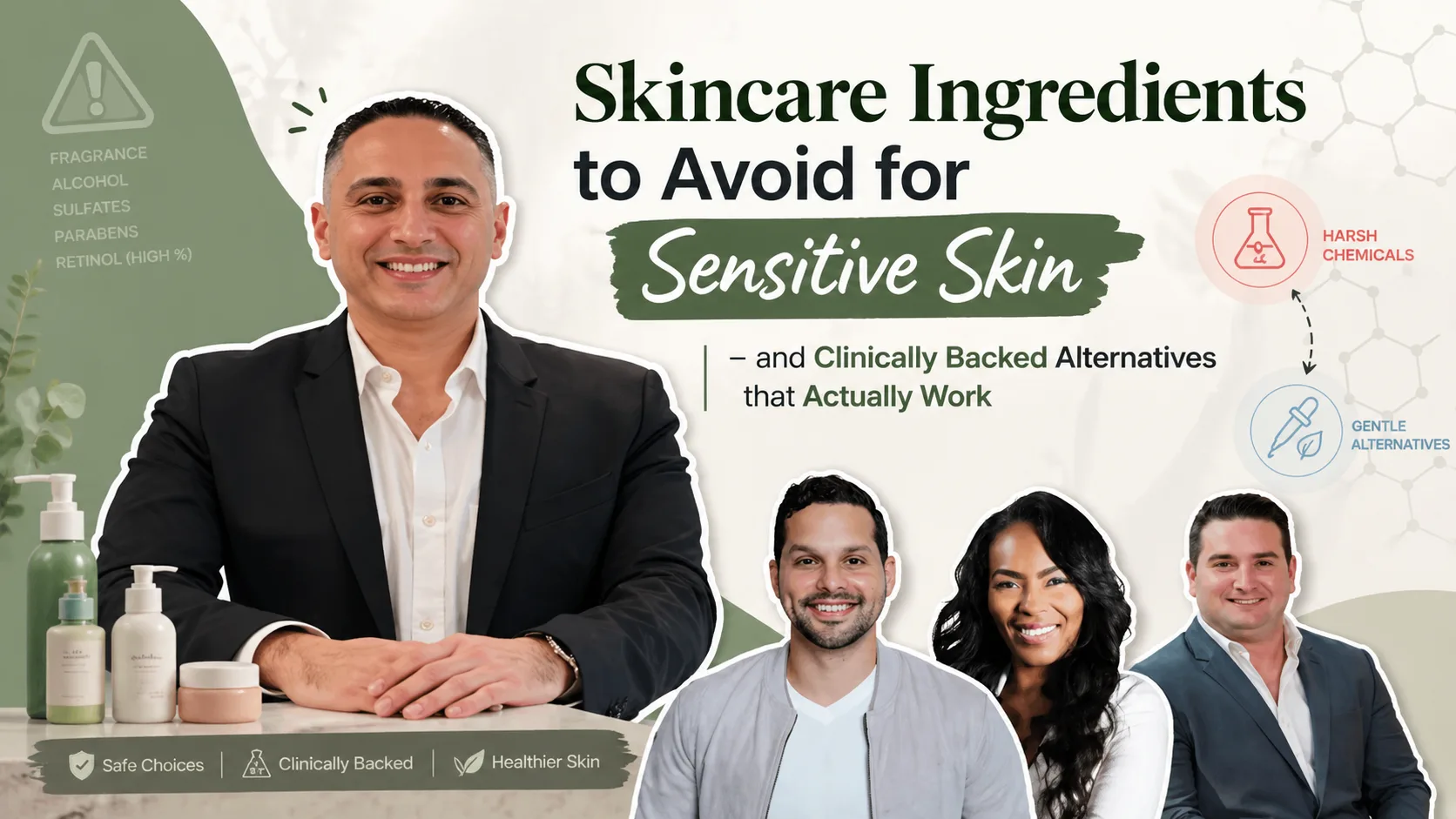
Sensitive skin doesn’t follow rules. An ingredient that transforms one person’s skin tone can leave another red, raw, and reactive within days. The frustrating part? Many of the most irritating culprits are also among the most aggressively marketed — retinol, glycolic acid, benzoyl peroxide, synthetic fragrance. They dominate shelves, trend on social media, and come backed by impressive before-and-after imagery. For reactive skin, though, they often do more damage than good. If you have been searching for gentle skincare alternatives for sensitive skin, you are in the right place.
In this edition of The Expert Edit, we cut through the noise. Drawing on verified expert insight and clinical dermatology research, you will find four high-risk ingredients sensitive skin should avoid — and the science-backed swaps that deliver results without compromising your skin barrier.
You don’t have to choose between results and calm skin. You just have to choose smarter.
1. High-Strength Retinol → Switch to Azelaic Acid
Retinol is often positioned as the non-negotiable of any serious anti-aging routine. For many skin types, that reputation is well earned. For sensitive, rosacea-prone, or barrier-compromised skin, however, high-strength retinol — particularly at 0.5% or above — frequently causes more harm than help.
Dr. Cameron Rokhsar, double board-certified dermatologist, fellowship-trained laser and MOHS surgeon, and Founder & Medical Director of the New York Cosmetic, Skin & Laser Surgery Center, sees this pattern repeatedly in his practice:
“Pure high-strength retinol is the ingredient I most often advise sensitive-skin patients to approach with caution. The routine recommendation to push beginners onto a 0.5 percent or 1 percent retinol gets many reactive-skinned patients into a barrier flare within the first few weeks, especially those with rosacea, perioral dermatitis, or a history of eczema. The anti-aging goal is real, but the path matters.”
His preferred alternative for this population? Azelaic acid — particularly for patients managing pigmentation concerns alongside sensitivity.
“Azelaic acid is well tolerated at 10 to 15 percent, has antibacterial and anti-inflammatory effects, and fades post-inflammatory hyperpigmentation without the redness and peeling that drive people off retinoids entirely. It is one of the most underused ingredients in dermatology, and for reactive skin I would often pick it before a retinoid at all.”
Research supports this strongly. Azelaic acid is a naturally occurring dicarboxylic acid derived from grains like barley and wheat. Unlike retinol, it does not compromise the skin barrier during use and is safe for long-term daily application — including during pregnancy. Randomised controlled trials have validated the 15% gel and 20% cream formulations, showing meaningful reductions in redness and inflammatory lesions with good tolerability in sensitive skin types.
For those committed to retinol-based results without the irritation, explore how to use retinol safely with a phased approach. For those ready to sidestep retinoids entirely, azelaic acid is the most clinically sound gentle skincare alternative for sensitive skin.
2. Strong AHAs (Glycolic Acid) → Switch to PHAs
Alpha hydroxy acids are a popular first step into chemical exfoliation — and glycolic acid, with its small molecular size, is among the most potent. That penetration depth is precisely what makes it effective. It is also exactly what makes it a liability for reactive skin.
Glycolic acid can strip the surface barrier and trigger redness, stinging, and prolonged sensitivity flares — particularly in skin already prone to inflammation. Marlene Brooks, Owner of Elite Dymond Designs Beauty School and an esthetics educator, explains the rationale behind a gentler swap:
“Our esthetics curriculum teaches students to prioritise skin integrity above all else. PHAs such as gluconolactone or lactobionic acid have larger molecular structures, providing a gentler, more superficial exfoliation that reduces irritation while still offering hydration and antioxidant benefits — making them significantly better for sensitive skin.”
Polyhydroxy Acids (PHAs) are the next-generation evolution of chemical exfoliants. They exfoliate at the surface level, rather than penetrating as deeply as glycolic acid, which means clearer, smoother skin — without the barrier disruption. Additionally, PHAs carry humectant properties, drawing moisture into the skin as they gently resurface it.
For those navigating chemical exfoliants for the first time, the principle is consistent: start mild, build slowly, and never layer multiple actives without testing tolerance first.
3. Aggressive Retinoids → Switch to Peptides
Prescription-strength retinoids are powerful, and for the right skin type, they deliver remarkable anti-aging results. For sensitive or reactive skin, though, the story is different. Their mechanism — accelerating cell turnover and increasing photosensitivity — can trigger dryness, redness, and barrier breakdown. For reactive skin, that cycle is genuinely counterproductive.
Scott Melamed, President & CEO of ProMD Health, a medical aesthetics practice, highlights an alternative that avoids the inflammatory response altogether:
“For sensitive or reactive skin, a dermatologist-approved alternative I’d recommend exploring is peptides. These short chains of amino acids act as building blocks for proteins like collagen and elastin, working gently to signal the skin to repair and rejuvenate itself — offering significant anti-aging benefits without the typical inflammatory response.”
Peptides work through a fundamentally different mechanism than retinoids. Rather than forcing accelerated turnover, they signal skin cells to produce more collagen and elastin naturally. It is a slower process — but one that works with the skin barrier, not against it. For sensitive skin, that distinction matters enormously.
Copper peptides, palmitoyl tripeptide-1, and Matrixyl 3000 are among the most studied. They pair well with hydrating supporting ingredients such as hyaluronic acid and niacinamide. Understanding how to layer your skincare correctly ensures peptides deliver maximum effect without ingredient conflict.
4. Synthetic Fragrance → Switch to Fragrance-Free Ceramide Barrier Care
Fragrance is perhaps the sneakiest of the skincare ingredients to avoid for sensitive skin. It hides in everything — moisturisers, serums, toners, even products marketed as “natural” or “clean.” Essential oils fall into this category too. Both can trigger allergic contact dermatitis, and both are frustratingly unpredictable: a formula that works beautifully for one person may cause a full-blown reaction in another.
Hans Graubard, COO & Co-founder of Happy V, a women’s wellness brand with a focus on skin barrier health, outlines the logic of going fragrance-free:
“Fragrance — including parfum and many essential oils — is a frequent trigger for irritation and allergic contact dermatitis, and it’s hard to predict who will react. A dermatologist-approved alternative that tends to work better is a fragrance-free barrier-support routine centred on ceramides plus humectants like glycerin and, for many people, soothing actives like colloidal oatmeal.”
Ceramides are lipid molecules that occur naturally in the skin and form a critical part of its protective barrier. When the barrier is compromised — as it often is in sensitive or reactive skin — ceramide-rich formulas help restore it from the outside in. Pair them with glycerin, a gentle humectant, and colloidal oatmeal, which has documented anti-inflammatory properties. Together, this combination is one of the most evidence-based approaches to calming reactive skin.
The rule is simple: if a product contains “fragrance,” “parfum,” or a list of essential oils, treat it as a potential trigger. When it comes to gentle skincare alternatives for sensitive skin, going fragrance-free isn’t a compromise — it’s frequently an upgrade.
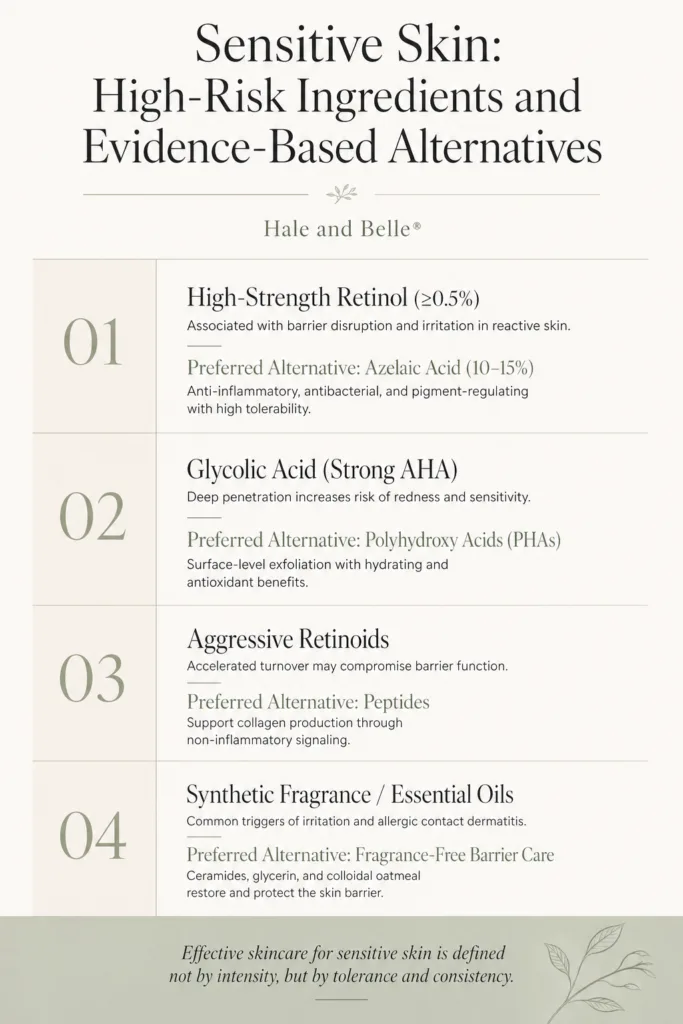
The Sensitive Skin Swap Guide at a Glance
About the Expert: Dr. Cameron Rokhsar
Dr. Cameron Rokhsar, MD, FAAD, FAACS is an internationally recognised dermatologist and one of the most credentialled cosmetic laser surgeons in the United States. A Harvard College graduate and NYU School of Medicine alumnus, he is double board-certified in dermatology and micrographic dermatologic surgery, and holds fellowship training in laser and cosmetic surgery from under the late Dr. Richard Fitzpatrick — widely regarded as the father of laser surgery.
Dr. Rokhsar is the Founder and Medical Director of the New York Cosmetic, Skin & Laser Surgery Center, which has treated over 100,000 patients across its Manhattan and Long Island locations. He also serves as Associate Clinical Professor of Dermatology at Mount Sinai Hospital, where he actively teaches cosmetic dermatology to the next generation of residents.
Among his clinical achievements, Dr. Rokhsar was involved in the development of the Fraxel laser — a technology that transformed the field of fractional resurfacing — and is credited as the inventor of the non-surgical nose job using fillers. He has been named a Castle Connolly Top Doctor for 20 consecutive years and a New York Magazine Best Doctor across multiple years. His work has been covered by the Today Show, Good Morning America, ABC News, CBS News, and Fox News.
In the context of sensitive skin care, Dr. Rokhsar’s clinical preference for azelaic acid over high-strength retinol reflects a pattern of evidence-led, patient-centred practice that prioritises long-term skin health over short-term trend compliance.
Frequently Asked Questions
Ingredients & Safety
A1: The most frequently problematic ingredients for sensitive or reactive skin are high-strength retinol, glycolic acid, benzoyl peroxide, and synthetic fragrance (including parfum and many essential oils). Each can disrupt the skin barrier, trigger inflammation, or cause allergic contact dermatitis.
A2: Yes. Azelaic acid at 10–15% is considered one of the best-tolerated active ingredients in dermatology. It is non-sensitising, has anti-inflammatory and antibacterial properties, and fades post-inflammatory hyperpigmentation — all without the barrier disruption associated with retinoids. It is also pregnancy-safe, which makes it suitable across a wide range of skin contexts. You can read more about how it compares to similar actives in our guide on niacinamide vs azelaic acid for acne scars.
A3: Check the INCI (International Nomenclature of Cosmetic Ingredients) list for “fragrance,” “parfum,” or individual essential oil names such as linalool, limonene, or citronellol. These are all potential sensitisers. If you are building a routine for reactive skin, opting exclusively for fragrance-free formulas removes one of the most common and unpredictable triggers.
A4: The best gentle skincare alternatives for sensitive skin work with the skin barrier rather than against it. Azelaic acid replaces high-strength retinol for anti-aging and pigmentation. PHAs replace glycolic acid for exfoliation. Peptides replace aggressive retinoids for collagen support. A fragrance-free ceramide routine replaces any product containing synthetic fragrance or parfum. Each swap delivers comparable results with significantly less irritation risk.
Building Your Routine
A4: Peptides are not a like-for-like replacement for retinoids, but they are a highly effective alternative for sensitive skin that cannot tolerate retinol’s side effects. They support collagen production through a gentler signalling mechanism and work well in combination with other barrier-supportive ingredients.
A5: The most effective gentle skincare alternatives for sensitive skin start with barrier repair — a fragrance-free ceramide cleanser, a ceramide-glycerin moisturiser, and daily SPF. Once the barrier is stable, introduce one active at a time. Azelaic acid is a strong first choice for most reactive skin types. Patch test every new product for at least 48–72 hours before full application.
Related Reads:
Want the latest scoop, exclusive deals, and skincare secrets? Follow us on WhatsApp and never miss a glow-up moment!