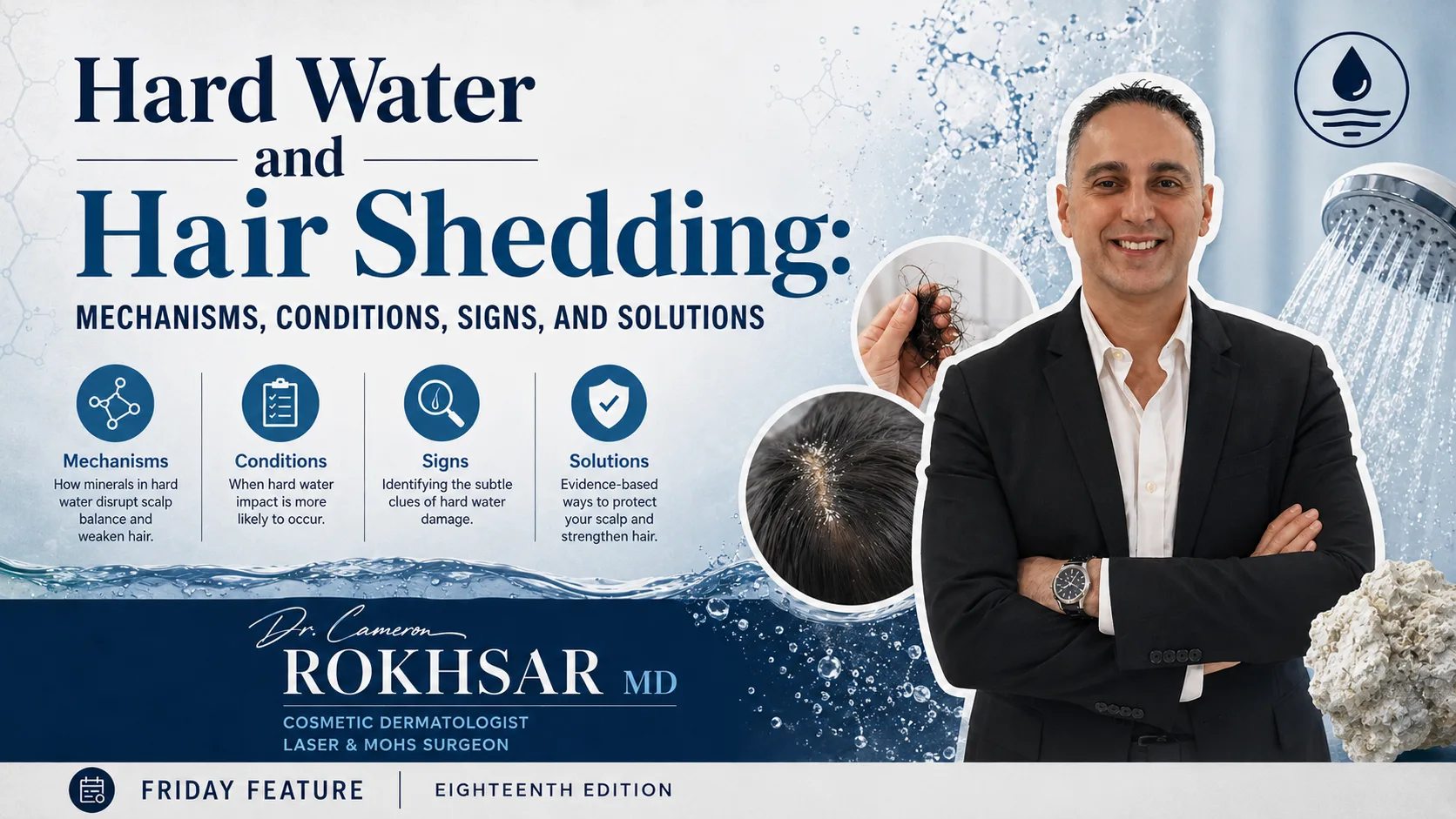
In its eighteenth edition, Hale and Belle’s Friday Feature series turns the spotlight on a hair concern that millions live with daily — without ever suspecting the source.
Your shower water could be quietly working against your hair — and most people have no idea. Here is what board-certified dermatology tells us about the link between hard water, hair shedding, and the steps that actually help.
Hard water is one of those silent hair villains that rarely gets the spotlight it deserves. You switch shampoos, try new scalp serums, and stress about every strand circling the drain — but nobody questions the water itself. Yet, for millions of people across India and beyond, the water flowing from their taps is laden with calcium, magnesium, and other dissolved minerals that could be quietly sabotaging the health of both hair and scalp.
This edition brings you a clinically precise, practically illuminating expert perspective on hard water hair fall — one that challenges some common assumptions and offers a clear path forward.
What Is Hard Water, and Why Does It Matter for Hair?
Hard water refers to water with high concentrations of dissolved minerals, primarily calcium and magnesium. It is found in a significant portion of Indian cities, where groundwater pulls these minerals from rock and soil during its journey to your tap.
When hard water meets your hair, the minerals bind to the negatively charged hair shaft. Over time, they leave behind a residue — a film that interferes with everything from shampoo performance to your hair’s natural elasticity. Understanding this mechanism is the first step toward managing hard water hair fall effectively.
Hard Water Hair Fall: Breakage vs. True Hair Loss
One of the most important distinctions in this conversation is the difference between hair breakage and true follicular hair loss. These are not the same thing, and conflating them leads to unnecessary panic and misguided treatment.
According to Dr. Cameron Rokhsar, Founder and Medical Director of the New York Cosmetic, Skin & Laser Surgery Center, hard water by itself rarely drives true follicular hair loss. Instead, it reliably worsens breakage, scalp irritation, and shedding that was already on the verge of becoming clinically noticeable.
The mechanism is worth understanding in detail. Mineral deposits — primarily calcium and magnesium — bind to the negatively charged hair shaft and to surfactants in shampoos. This leaves a film that stiffens the cuticle, reduces fibre elasticity, and makes detangling far more traumatic than it needs to be. The result is increased mechanical breakage, which shows up as shedding on your pillow, in your hairbrush, and along the shower drain.
Importantly, this is not the same as your follicles producing fewer hairs or hairs entering a resting phase prematurely. However, it can certainly look and feel like it — particularly when compounded by other underlying conditions.
Who Is Most Vulnerable to Hard Water Hair Fall?
Not everyone is equally affected by hard water. Dr. Rokhsar identifies a specific group of patients who tend to experience the most significant impact: those who are already “running below the waterline.”
This includes:
- Women with telogen effluvium following illness, surgery, crash diets, or the postpartum period
- Patients on chemotherapy who are in the hair regrowth phase
- Anyone with seborrheic dermatitis or atopic scalp inflammation
The pattern here is telling. Hard water does not create these conditions — but it significantly amplifies them. For a woman already experiencing postpartum hair shedding, for example, a hard water environment can push what might have been manageable shedding into something that looks and feels alarming. If you are navigating postpartum hair fall alongside a hard water household, expert-backed guidance on 5 Postpartum Hair Loss Treatments That Actually Work offers a useful companion read.
On the scalp itself, mineral residue pairs with product buildup and feeds a low-grade dermatitis. The hair then appears thinner because density is already decreasing, and the broken ends contribute to a wispy, visibly depleted look. This combination of genuine shedding and mechanical breakage makes hard water hair fall particularly hard to diagnose without expert input.
What Does Hard Water Do to the Scalp?
Beyond the hair shaft, hard water has distinct effects on the scalp environment. Mineral deposits accumulate alongside sebum and styling product residue, creating a hostile surface for healthy follicle function.
This buildup can manifest as a low-grade, persistent inflammation — sometimes resembling seborrheic dermatitis or atopic dermatitis — that does not respond to standard dandruff shampoos. This is a crucial clinical clue. When scalp flaking persists despite regular antidandruff treatment, hard water mineral buildup may be part of the picture.
Scalp health is, of course, foundational to hair health. A compromised scalp barrier reduces the effectiveness of every serum, oil, or treatment you apply. For a deeper understanding of why the scalp is where hair health truly begins, the Hale and Belle guide on Why Scalp Exfoliation Deserves a Place in Your Haircare Routine is worth bookmarking.
Clinical Signs That Hard Water May Be Affecting Your Hair
Knowing when to suspect hard water as a contributing factor is practical and empowering. Based on Dr. Rokhsar’s 25 years of clinical practice in Manhattan and Long Island, here are the dermatological signs that point toward hard water as a culprit:
- Sudden dullness with no obvious change in products or routine
- Coarser texture than you remember, despite regular conditioning
- More tangling after washing, even with the same detangling routine
- Persistent flaking that does not respond to antidandruff shampoos
- Hair that feels stiff or coated rather than clean and smooth after washing
These signs are especially significant when they appear after a move to a new city or home — a classic scenario where the change in water quality maps directly onto a change in hair behaviour.
What the Science Says: Mineral Buildup and Hair Integrity
Research published in the International Journal of Trichology examined the effects of hard water on hair, finding that repeated exposure to water with high calcium and magnesium concentrations reduces tensile strength and elasticity compared to distilled water. In practical terms, this means hard-water-treated hair is more likely to snap under the mechanical stress of combing, styling, and even gentle detangling.
Separately, cosmetic chemistry research has demonstrated that mineral ions — particularly calcium and magnesium — interfere with how shampoos and conditioners perform. They bind to the conditioning agents in your products, reducing their ability to deposit on the hair shaft. This is why hair washed in hard water often feels less soft and more resistant to moisture, regardless of how good your conditioner is.
This science underpins why addressing hard water is not just about the water — it is about restoring your hair’s ability to respond to the treatments you are already investing in.
Preventive and Corrective Measures: What Actually Works
Dr. Rokhsar is specific about what helps — and what does not go far enough.
1. Shower-Head Water Filters
According to Dr. Rokhsar, installing a shower-head filter is the single most useful preventive step. These filters work by reducing the concentration of calcium, magnesium, and other dissolved minerals before the water ever reaches your hair. They are widely available, relatively affordable, and require no change to your washing routine. This is the most foundational intervention for households where hard water hair fall is a concern.
2. Chelating Shampoos with EDTA or Tetrasodium Etidronate
This is where Dr. Rokhsar draws an important line between clarifying shampoos and chelating shampoos — a distinction many consumers miss entirely.
Standard clarifying shampoos are effective at removing surface-level product residue, but they do not fully strip calcium deposits from the hair shaft. Chelating shampoos, by contrast, contain chelating agents — specifically EDTA (ethylenediaminetetraacetic acid) or tetrasodium etidronate — that chemically bind to mineral ions and allow them to be rinsed away. These agents grip the metal ion with multiple binding points, forming a water-soluble complex that lifts off during rinsing. (Source: Cosmetic Chemistry Research)
Dr. Rokhsar recommends periodic use of a chelating shampoo — not daily, as these formulations can strip essential oils alongside minerals. Every one to three weeks is the generally accepted frequency, followed by a deep conditioning mask to restore hydration.
3. Deep Conditioning After Chelation
Every strong chelating or clarifying wash should be followed by a nourishing conditioner or hair mask. Because chelating agents remove mineral buildup so thoroughly, they can temporarily leave the hair shaft more porous and prone to moisture loss. Restoring hydration immediately after treatment ensures the hair’s condition improves rather than swings from one form of damage to another.
4. Scalp-Focused Care
Because hard water affects the scalp environment as much as the hair shaft, a targeted scalp care approach complements the treatments above. Regular, gentle scalp exfoliation helps clear mineral residue and product buildup from the follicular environment — something regular shampoos simply cannot reach. This creates a cleaner, more responsive scalp for serums and treatments to work on. For more on choosing between scalp oils and hair serums in your routine, the Hale and Belle guide on Scalp Oils vs Hair Serums: Which One Does More for Growth? provides practical direction.
Meet the Expert
Dr. Cameron Rokhsar — Double Board-Certified Dermatologist, New York
Dr. Cameron Rokhsar, MD, is an internationally renowned dermatologist and fellowship-trained laser and MOHS surgeon, double board-certified in dermatology and micrographic dermatologic surgery. A graduate of Harvard College and NYU School of Medicine, he is the founder and Medical Director of the New York Cosmetic, Skin, and Laser Surgery Center — one of the most prestigious dermatology practices in New York City and Long Island.
Dr. Rokhsar serves as an Associate Clinical Professor of Dermatology at Mount Sinai Hospital, where he teaches the cosmetic dermatology clinic and actively trains the next generation of dermatologists. His clinical research spans laser systems, skin cancer surgery, and non-surgical cosmetic procedures — and he has been involved in the development of multiple laser technologies, including the landmark Fraxel laser.
Dr. Rokhsar has been recognised as a “Top Doctor” by Castle Connolly, US News World Health, Top Doctors New York Times, SuperDoctors, and New York Magazine for multiple consecutive years. His practice has treated over 100,000 patients across Manhattan and Long Island, and his commentary on dermatological topics has appeared on the Today Show, Good Morning America, ABC News, CBS News, and Fox News.
You can learn more about Dr. Rokhsar and his practice at cosmeticlaserskinsurgery.com.
The Bottom Line on Hard Water Hair Fall
Hard water hair fall is real — but the mechanism matters. Hard water does not typically destroy healthy follicles from the inside out. Rather, it creates the conditions for increased breakage, scalp irritation, and amplified shedding in those who are already vulnerable. The mineral buildup it leaves behind stiffens the cuticle, degrades elasticity, disrupts the scalp environment, and undermines the performance of every product you use.
The good news is that this is one of the more actionable causes of hair shedding. A shower-head filter addresses the source. A chelating shampoo with EDTA clears what a clarifying wash cannot. A consistent scalp care routine maintains the follicular environment. And understanding the distinction between true hair loss and mechanical breakage helps you respond with the right level of intervention — calm and targeted, rather than panicked and reactive.
If persistent shedding, scalp flaking unresponsive to dandruff shampoos, or sudden dullness and coarseness describe your experience, a board-certified dermatologist can help distinguish the contribution of water quality from other underlying factors.
Related Reading on Hale and Belle:
- 5 Expert-Backed Postpartum Hair Loss Treatments That Actually Work
- Why Scalp Exfoliation Deserves a Place in Your Haircare Routine
- Scalp Oils vs Hair Serums: Which One Does More for Growth?
- Exploring Effective Hair Growth Ingredients: Beyond Minoxidil
Want the latest scoop, exclusive deals, and skincare secrets? Follow us on WhatsApp and never miss a glow-up moment!