Most skincare operates at the surface. Moisturisers hydrate the stratum corneum. Serums deliver actives into the upper epidermis. Even clinical treatments like lasers and peels work primarily by inducing controlled damage — hoping the skin responds by rebuilding itself. For many people, these approaches work well enough. For others, they don’t. The skin repairs superficially, then reverts. Pigmentation returns. Barrier dysfunction persists. The gap between cosmetic correction and actual skin repair is significant. Exosome skin treatment exists precisely to close it.
What Is Exosome Skin Treatment?
Exosome skin treatment is a regenerative medical procedure that delivers extracellular vesicles — specifically exosomes — into the skin to activate cellular repair, modulate inflammation, and stimulate collagen synthesis. Unlike conventional topical or energy-based treatments, exosome therapy operates at the signalling level: it communicates directly with skin cells, instructing them to behave as they would in a state of optimal health and repair.
This is not a surface treatment. It is a cellular intervention.
What Are Exosomes? The Biology Behind the Therapy
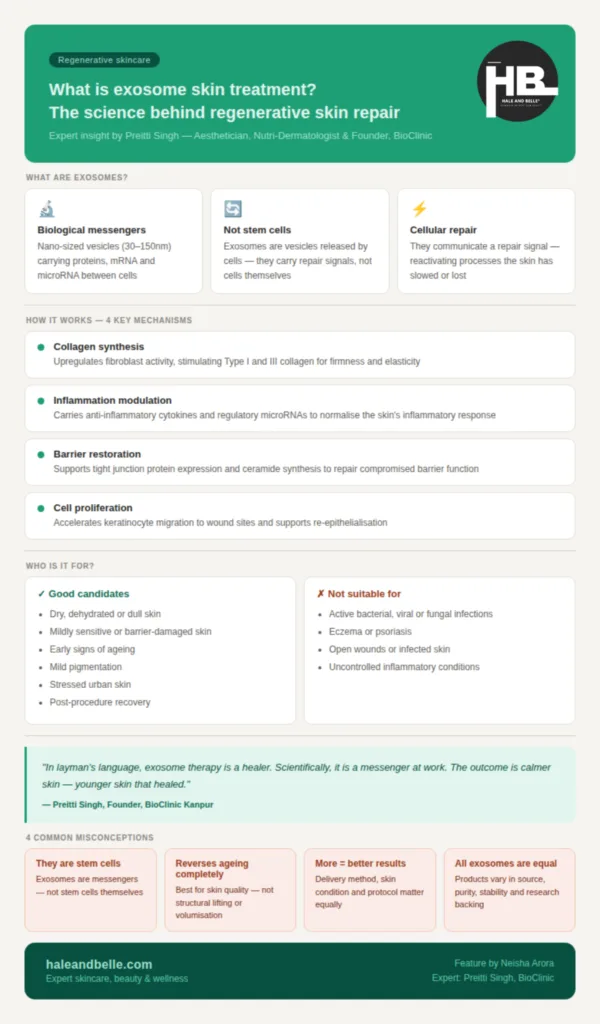
Virtually every cell type in the body releases exosomes — nano-sized extracellular vesicles, typically 30 to 150 nanometres in diameter. They function as biological messengers — carrying proteins, lipids, and genetic material (including mRNA and microRNA) from one cell to another.
In the context of skin biology, exosomes derived from stem cells play a particularly significant role. They carry growth factors such as TGF-β, VEGF, and EGF, alongside signalling molecules that regulate inflammation, extracellular matrix production, and barrier restoration. When introduced into compromised or ageing skin, these vesicles effectively communicate a repair signal — reactivating processes that the skin has slowed or lost altogether.
Preitti Singh, aesthetician, nutri-dermatologist, and founder of BioClinic, puts it plainly:
“In layman’s language, exosome therapy is a healer. Scientifically, it is a messenger at work. The outcome is calmer skin — skin that looks fresh, rejuvenated, and has its oxidative stress and inflammation taken care of. Younger skin that healed.” — Preitti Singh, Founder, BioClinic
This distinction matters. Exosome therapy does not replace skin function. It restores it.
Why Most Skincare Fails to Repair
The skincare industry is largely symptom-driven. A patient presents with uneven texture, and the clinician prescribes exfoliants. Another shows early pigmentation, and they receive vitamin C. The logic is intuitive, but the approach is incomplete. It addresses what is visible rather than what is causing it.
Clinicians rarely treat barrier dysfunction at its source — a compromised lipid matrix, dysregulated microbiome, and impaired tight junction signalling. Topicals can support barrier function, but they cannot restore it at the cellular level without addressing the underlying biological environment.
This is where many conventional treatments reach their ceiling. They can improve the appearance of skin. They cannot systematically change how the skin functions.
At BioClinic, the protocol begins before any treatment decision. Each client undergoes a comprehensive skin mapping assessment — the team evaluates inflammatory load, barrier integrity, hydration levels, and repair capacity — before considering exosome therapy. Diagnosis is not a preliminary step. It is the foundation of the entire approach.
Skincare missteps are rarely dramatic. They accumulate quietly — in the wrong treatment at the wrong time, in stress that shows up as inflammation, in a barrier pushed past its limit. Preitti Singh explores exactly these patterns in the Skin Sins series on Hale and Belle, unpacking the habits that silently undermine skin health long before a clinical concern becomes visible. It is worth reading alongside this piece.
How Exosome Skin Treatment Works
When clinicians introduce exosomes into the skin — typically via microneedling, intradermal injection, or topical application post-ablation — keratinocytes, fibroblasts, and immune cells in the dermis and epidermis take them up. The uptake triggers a cascade of downstream biological responses.
Collagen synthesis:
Exosomes deliver growth factors that upregulate fibroblast activity, stimulating the production of Type I and Type III collagen — the structural proteins responsible for skin firmness and elasticity.
Inflammation modulation:
Many skin concerns, from acne scarring to rosacea, involve chronic low-grade inflammation. Exosomes carry anti-inflammatory cytokines and regulatory microRNAs that help normalise the inflammatory response, rather than simply suppressing it.
Barrier restoration:
Signalling molecules within exosomes support tight junction protein expression and ceramide synthesis, directly addressing compromised barrier function.
Cell proliferation and migration:
In post-procedural or damaged skin, exosomes accelerate the migration of keratinocytes to wound sites and support re-epithelialisation — the biological process that closes and heals the skin.
The treatment does not impose cosmetic improvement from outside. The skin generates biological improvement from within.
Exosome Facial vs. Traditional Facials
The term “exosome facial” has entered the treatment vocabulary, often positioned alongside hydrafacials and LED therapies as a premium add-on. This framing is imprecise — and potentially misleading.
A traditional facial is an experience. It cleanses, hydrates, and may temporarily improve the appearance of skin. Results are real but transient. There is no lasting change to cellular function.
An exosome facial — when administered clinically — is a medical procedure. The delivery mechanism, the concentration and source of exosomes, the preparation of the skin, and the post-treatment protocol all determine whether the treatment produces meaningful biological change or remains a surface event.
The differentiation is not about prestige. It is about mechanism. Exosome therapy is only regenerative when applied in a context where regeneration is biologically possible — and that requires clinical assessment, not booking an appointment.
Who Is an Appropriate Candidate for Exosome Skin Treatment?
Exosome therapy does not suit every patient. Its strongest applications are in patients whose skin has a defined regenerative deficit — where the repair machinery exists but is underperforming.
According to Preitti Singh, ideal candidates include those with dry, dehydrated, or dull skin; mildly sensitive or barrier-damaged skin; early signs of ageing; mild pigmentation; stressed urban skin; and anyone in post-treatment recovery.
“Exosome therapy also heals anyone who has had any procedure on their face. It is the mother of all treatments on skin — all it does is simply nurture you.” — Preitti Singh, Founder, BioClinic
Equally important is understanding who should not receive this treatment.
“A client with any bacterial, viral, or fungal skin infection should not undergo exosome therapy. It can be dangerous and cause spreading. We also declare it inappropriate for skin with eczema, psoriasis, open wounds, or any active infection. In these cases, the client is simply unfit to have exosome therapy performed.” — Preitti Singh, Founder, BioClinic
This clinical clarity matters. Exosome therapy is a tool for regeneration — not rescue. It works best when the biological environment is stable enough to receive and act on its repair signals.
Clinical Benefits of Exosome Skin Treatment
Framed accurately, the clinical benefits of exosome skin treatment include:
Tissue repair and regeneration:
Structural improvement in dermal architecture through collagen remodelling and elastin stimulation — not surface hydration.
Accelerated post-procedure recovery:
Reduced erythema, faster wound closure, and shortened downtime when used alongside ablative procedures.
Texture refinement:
Improvement in skin surface irregularity through increased keratinocyte turnover and extracellular matrix reorganisation.
Reduction in inflammatory load:
Measurable decrease in chronic low-grade skin inflammation, with downstream benefit for pigmentation and sensitisation.
Hydration and barrier support:
Restoration of the skin’s moisture-retention capacity through ceramide synthesis and tight junction repair — particularly valuable in dehydrated and barrier-compromised skin types.
Long-term functional improvement:
Unlike topical treatments, which require continuous application to maintain benefit, exosome therapy — administered correctly — can produce durable changes in skin function that persist beyond the treatment window.
These outcomes are not guaranteed. They are contingent on correct patient selection, appropriate delivery, and an evidenced treatment protocol.
The Role of Diagnosis Before Treatment
No one simply selects exosome therapy from a menu. It is a clinical decision — and that decision requires diagnostic precision.
Advanced skin analysis platforms now allow clinicians to assess barrier integrity, hydration levels, sebum distribution, inflammatory markers, and pigmentation depth with clinical accuracy. This data informs not just whether exosome therapy is appropriate, but how the clinician should deliver it, at what concentration, and in what combination with other treatments.
At BioClinic, every client undergoes a detailed skin mapping consultation before the team initiates any regenerative protocol. The clinician assesses each skin individually — evaluating inflammatory status, hydration levels, barrier integrity, and repair capacity — and customises the treatment plan accordingly. As Singh explains, some skins require an additional top-up of antioxidants; others need collagen stimulants or targeted anti-inflammatory support alongside exosomes.
“Each skin needs a different frequency and procedure, with a customised need for a particular top-up of antioxidants, collagen stimulants, extra hydration, or anti-inflammatories. We map it all at BioClinic.” — Preitti Singh, Founder, BioClinic
This approach reflects a broader clinical principle: precision over guesswork. In regenerative medicine, the gap between a well-prescribed treatment and a poorly prescribed one is not marginal. It determines whether the skin repairs — or simply reacts.
Safety and Clinical Considerations
Exosome therapy, when sourced from reputable manufacturers and administered in a clinical setting, has a well-tolerated safety profile. Common post-procedure responses include mild erythema, transient sensitivity, and minimal swelling at the delivery site — all of which resolve within 24 to 72 hours.
Several factors require careful clinical consideration, however.
Source and standardisation:
The quality of exosome preparations varies significantly across the market. Exosome products differ in source, purity, stability, processing method, and research backing — and these differences directly affect clinical outcome. Patients should confirm that their clinician uses preparations with documented characterisation and standardised particle concentration.
Delivery mechanism:
Topical application of exosomes onto intact skin produces limited efficacy due to the skin’s barrier function. Effective delivery requires a controlled breach of the epidermis — via microneedling, fractional laser, or injection — to ensure sufficient dermal penetration.
Regulatory context:
The regulatory classification of exosomes varies by jurisdiction. In most countries, they are categorised as advanced therapy medicinal products and should only be administered by licensed medical practitioners.
Realistic expectations:
Exosome therapy is not immediate. Cellular regeneration operates on biological timelines. Meaningful collagen remodelling becomes visible over six to twelve weeks. Non-invasive exosome therapy, in particular, excels at improving skin quality, hydration, inflammation reduction, and recovery support — rather than delivering structural lifting or dramatic volumisation.
Common Misconceptions About Exosome Therapy
As exosome treatments gain visibility, several persistent misconceptions have entered the public conversation. Preitti Singh addresses the most clinically significant ones directly.
“Exosomes are stem cells.”
This is one of the most frequently repeated misunderstandings. Exosomes are not stem cells — they are extracellular vesicles released by cells, including stem cells. They carry repair and recovery signals, but they are messengers, not the cells themselves. The distinction matters both scientifically and for setting accurate patient expectations.
“Exosome therapy can completely reverse ageing.”
Singh is clear on this point. Non-invasive exosome therapy excels at improving skin quality — hydration, inflammation reduction, barrier repair, and overall skin health. It is not a substitute for structural interventions. Wrinkles do not disappear overnight. Sagging does not lift dramatically. Expecting facelift-level transformation from exosome therapy reflects a fundamental misunderstanding of what the treatment actually does.
“More exosomes equals better results.”
Concentration alone does not determine outcome. Results depend equally on the delivery method, the condition of the skin, existing inflammation levels, formulation quality, and the overall treatment protocol. A high-concentration product with poor formulation and an undiagnosed inflammatory skin condition may perform significantly worse than a well-designed, lower-concentration regenerative protocol administered in the right clinical context.
“All exosomes are the same.”
They are not. Exosome products vary dramatically in source, purity, stability, processing method, and research backing. Patients who select a treatment based on marketing claims rather than clinical evidence risk inconsistent results — or worse, an adverse response in compromised skin.
Takeaway: The Future of Skin Treatment Is Regenerative
The trajectory of skin science is moving away from correction and toward repair. Not because correction is without value — but because it addresses consequences rather than causes.
Exosome skin treatment represents a meaningful shift in clinical thinking. By targeting cellular signalling rather than surface appearance, it aligns skincare with the biological reality of how skin actually heals, regenerates, and ages. Applied with diagnostic rigour and clinical precision, it offers something most skincare cannot: lasting functional change at the cellular level.
The most effective skin treatments of the next decade will not ask how to improve how skin looks. They will ask why the skin is failing to repair itself — and intervene at that level.
That is not a trend. That is the direction of medicine.
Frequently Asked Questions
Understanding Exosome Skin Treatment
A: An exosome facial is a clinical skin treatment in which exosomes — nano-sized extracellular vesicles derived from stem cells — are delivered into the skin via microneedling or post-ablative application. Unlike conventional facials, which address the skin’s surface, an exosome facial works at the cellular level to activate tissue repair, modulate inflammation, and stimulate collagen production. The term “facial” can be misleading: this is a medical procedure requiring clinical assessment and is not comparable to standard spa or aesthetic treatments.
A: No. Exosomes are extracellular vesicles — tiny messenger particles released by cells, including stem cells. They carry the signalling molecules that instruct skin cells to repair and recover, but they are not stem cells themselves. Understanding this distinction is important for setting realistic expectations about what exosome therapy can and cannot achieve.
A: Not necessarily. Outcome depends on multiple factors: the delivery mechanism, the skin’s baseline condition, existing inflammation levels, formulation quality, and the overall treatment protocol. Concentration is one variable among many. A well-designed regenerative protocol administered in the right clinical context will consistently outperform a high-concentration product applied without diagnostic rigour.
Efficacy, Candidacy & Safety
A: Clinical evidence indicates that exosome skin treatment produces measurable improvements in collagen density, barrier function, skin texture, and post-procedural recovery — particularly in patients with documented regenerative deficits. Efficacy depends significantly on the quality of the exosome preparation, the delivery mechanism used, and the appropriateness of patient selection. Results are not immediate; biological remodelling becomes visible over a six to twelve week period.
A: Unlike topical treatments that require continuous application to maintain effect, exosome therapy can produce durable changes in skin function. Patients typically report sustained improvements in texture, barrier integrity, and skin quality for six months to over a year following a course of treatment. Longevity depends on the individual’s skin biology, lifestyle factors, and whether maintenance sessions are incorporated into a long-term skin health protocol.
A: Ideal candidates include those with dry, dehydrated, dull, or mildly sensitive skin; early signs of ageing; mild pigmentation; barrier damage; stressed urban skin; and anyone recovering from a prior skin procedure. Clinical evaluation determines candidacy — self-selection based on trend or marketing is not a sound basis for treatment.
A: Exosome therapy is contraindicated in clients with active bacterial, viral, or fungal skin infections; eczema; psoriasis; open wounds; or any infected skin. In these cases, treatment could accelerate the spread of infection or trigger adverse responses. These conditions must resolve and the skin must stabilise before any regenerative protocol begins.
Hale and Belle presents medical and clinical content for informational purposes. This article does not constitute medical advice. Consult a qualified dermatologist or skin clinician before pursuing any skin treatment.
Want the latest scoop, exclusive deals, and skincare secrets? Follow us on WhatsApp and never miss a glow-up moment!