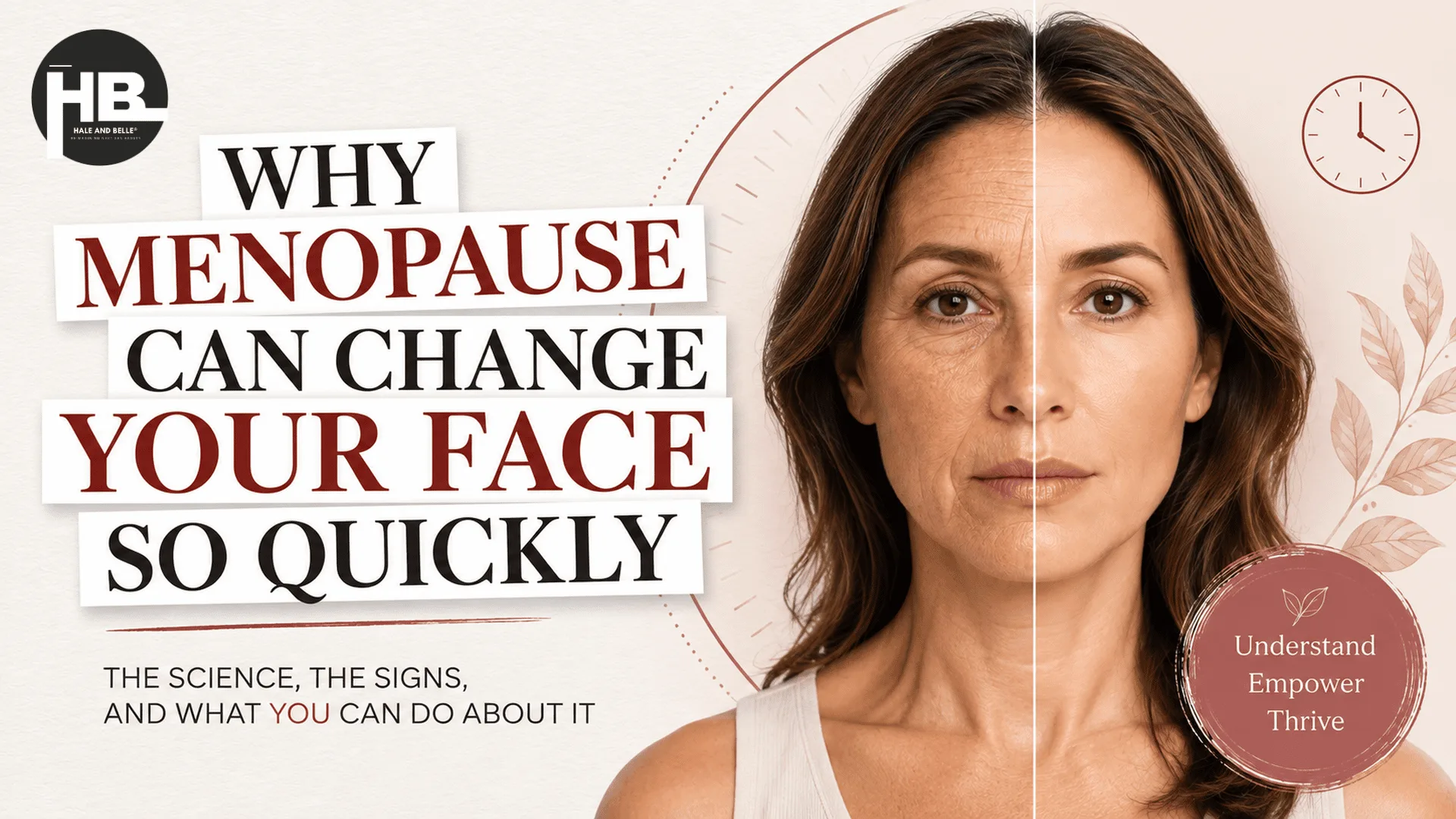
Somewhere between one birthday and the next, many women notice a shift in the mirror that feels less like gradual ageing and more like a sudden departure. The cheeks look a little hollower. The skin feels thinner, drier, less forgiving of a bad night’s sleep. Pores that were barely visible last year now seem to demand attention. For a lot of women, this isn’t a gradual slide — it’s a season of change that arrives with perimenopause and menopause, and it can feel disorienting precisely because it happens faster than the years alone would predict.
The experience is real, and there is a biological reason behind it. Skin is one of the body’s most estrogen-sensitive organs, and the hormonal shift of the menopausal transition can compress years of typical skin ageing into a much shorter window. Understanding why that happens — and what genuinely helps — matters more than another list of products.
Why Does Menopause Change the Face So Quickly?
In short: estrogen helps maintain the collagen, elastin, hydration and thickness of the skin, and when estrogen levels fall during the menopausal transition, several of these processes decline at once rather than one at a time. That convergence is what makes the change feel sudden rather than slow.
Research backs up what women report anecdotally. A widely cited review published in the Journal of the American Academy of Dermatology found that postmenopausal women lose roughly 1 to 2 percent of their skin’s collagen content every year, with the most rapid decline concentrated in the years immediately around menopause. More recent research puts the early loss even higher, suggesting that women can lose up to 30 percent of their skin’s collagen within the first five years after menopause, a pace that then slows but continues over time. A 2025 narrative review in the Journal of Cosmetic Dermatology similarly describes the perimenopausal years as a period of accelerated decline in skin quality, driven specifically by falling estrogen and its effect on collagen production and the skin’s structural framework.
As Pretti Singh, Founder of BioClinic and a Nutri-Dermatology Expert, puts it: skin is an estrogen-responsive organ, and the changes that show up on the face tend to track the pace of hormonal change in the body. When estrogen declines quickly, as it often does in the perimenopausal years, the visible effects — dullness, dryness, loss of facial volume — can appear to arrive all at once.
How Estrogen Influences Your Skin
Estrogen works on the skin through estrogen receptors, found in the epidermis, the dermis and the fibroblasts that live within it. Fibroblasts are key skin cells that generate collagen, elastin and extracellular matrix components, helping maintain the skin’s strength and structural integrity. When estrogen is plentiful, these receptors help keep fibroblast activity — and collagen production — running at a healthy rate.
Singh describes this connection directly: estrogen is linked to the dermal fibroblasts that build collagen, and as estrogen receptors on those cells become less active, collagen production slows. Elastin, the protein responsible for skin’s ability to stretch and spring back, is affected in a similar way. So is the skin’s capacity to hold onto hyaluronic acid, the molecule largely responsible for keeping skin plump and hydrated.
Research on postmenopausal skin has consistently linked estrogen deprivation to several measurable changes: thinner epidermis, reduced dermal collagen, lower skin moisture, decreased firmness and slower wound healing. None of these changes happen in isolation — they overlap, which is part of why the cumulative effect on the face can look more dramatic than a single year of ordinary ageing would suggest.
Why Your Face Can Look Different During Menopause
Facial volume loss is one of the most noticeable menopausal skin changes, and it isn’t purely a collagen story. As collagen and elastin decline, skin loses some of its ability to hold its shape against gravity. At the same time, changes in facial fat distribution and, in some women, mild muscle laxity can shift how the lower face and jawline sit.
Singh describes what this looks like in practice: faces can appear to lose volume, cheeks may look more hollow, and the area beneath the jaw can look less defined — changes that patients often describe as their face looking “caved in” rather than simply older. In skin that was naturally thicker, this loss of underlying support can also translate into visible sagging, since there is more tissue that now has less structural backing.
Pore size is part of the same picture. Contrary to a common assumption that enlarged pores are mainly about oil production, reduced elasticity and hydration around each pore opening can make pores look more pronounced, simply because there is less taut, well-hydrated skin holding their edges in place. Singh points to this directly, noting that reduced elasticity and hydration during menopause are common contributors to the appearance of larger pores.
Why Dryness, Dullness and Sensitivity Become More Noticeable
Estrogen also plays a role in the skin’s barrier function — the outermost layer that keeps moisture in and irritants out — and in the skin’s natural oil production. As estrogen declines, many women notice their skin holding less moisture and producing less natural oil, which shows up as dryness and, often, a duller overall complexion, since dehydrated skin reflects light less evenly.
Singh frames this as a shift in the skin’s overall balance: the harmony that skin held in earlier decades changes, dryness sets in, and dullness tends to follow closely behind. Her practical observation is one many dermatologists share — a skincare routine that worked well in someone’s thirties may simply not do enough in her forties or fifties, and the right response is usually to reassess and adjust rather than assume something is wrong with the skin itself.
A compromised barrier also makes skin more reactive. Products that were previously well tolerated can start to cause stinging, redness or tightness, because a thinner, drier barrier has less capacity to buffer against actives, fragrance or even weather changes. Singh notes that in more severe cases of dryness, increased sensitivity is a common accompanying sign — a useful cue that a routine may need to be simplified rather than intensified.
What About Pigmentation and Enlarged Pores?
Pigmentation is a genuinely more complicated part of this story, and it deserves a careful answer rather than a simple one. Menopause does not directly cause pigmentation in the way it directly affects collagen. Instead, several factors tend to converge in this life stage: cumulative years of sun exposure, a naturally slower skin cell turnover rate, hormonal fluctuation, and — for some women — the tail end of pregnancy-related pigmentation (melasma) that resurfaces or persists. A thinner, less hydrated skin barrier can also make existing pigmentation look more pronounced, simply because the skin around it has lost some of its evenness.
The honest answer is that menopause is one contributing factor among several, rather than a standalone cause. This is precisely why a personalised assessment — ideally from a dermatologist or qualified skin professional — tends to serve women better than assuming a single explanation covers every pigmentation concern.
Is Menopause Really “Accelerating” Facial Ageing?
This question deserves precision, because the language used here matters. Menopause is a normal biological transition, not a disease or a disorder — every woman who reaches a certain age will go through it. What the research does support is more specific: the drop in estrogen that defines the menopausal transition can accelerate certain visible aspects of skin ageing, particularly those tied to collagen density, dermal thickness, hydration and elasticity, within a shorter window than chronological ageing alone would produce.
Singh’s professional experience aligns with this nuance, and she describes menopause as a stage that can bring ageing signs forward more visibly. It is worth being equally precise about what comes next. Topical skincare and in-clinic treatments can meaningfully improve how skin looks and feels — smoother texture, better hydration, improved tone — and they can support the skin’s own collagen production over time. What they cannot do is reverse the underlying biological ageing of the body. “Age reversal,” used loosely, oversells what any topical product or treatment is capable of. A more accurate way to describe the goal is supporting skin quality and slowing the visible signs of ageing, not undoing ageing itself.
Beyond Skincare: Nutrition, Protein, Exercise and Sleep
Skincare is only one lever, and arguably not the most powerful one. Singh is clear that nutrition and lifestyle needs are highly individual — what works for one woman’s skin will not necessarily work for another’s — but she highlights several factors that consistently matter: adequate essential fatty acids, sufficient protein, and antioxidant-rich foods, in combinations tailored to the person rather than applied generically.
Sleep is another factor she emphasises specifically, describing the value of maintaining a consistent sleep schedule in line with the body’s circadian rhythm. This aligns with broader research on skin health, which has linked poor sleep quality to a weaker skin barrier and slower overnight repair processes — the hours when skin does much of its regeneration.
Diet quality matters too. Singh points to reducing sugar intake and minimising fried, overcooked, or heavily charred food, alongside adequate hydration, as habits that support skin from the inside. Strength training deserves its own mention here: resistance exercise helps preserve lean muscle mass, which tends to decline during the menopausal transition, and adequate muscle mass under the skin can support a more resilient-looking facial and body structure as women age.
How Should Women Change Their Skincare After 40?
There is no single routine that suits every woman navigating perimenopause or menopause, and treating this stage as one uniform experience does most women a disservice. That said, a few adjustments tend to come up often in professional guidance:
- Reassess actives that may now be too harsh for a thinner, drier barrier, and consider introducing gentler alternatives.
- Prioritise barrier-supporting ingredients — ceramides, ceramide precursors, and humectants like hyaluronic acid — over aggressive exfoliation.
- Add daily broad-spectrum sun protection if it isn’t already a habit, since UV exposure compounds collagen loss that is already occurring hormonally.
- Consider ingredients with evidence behind supporting collagen production, such as retinoids, introduced gradually and matched to the skin’s current tolerance.
- Treat sensitivity as information rather than a nuisance — a sign to simplify a routine, not push through it.
Singh’s overarching advice is to seek guidance from a qualified professional rather than relying solely on personal trial and error, particularly because the skin’s needs at this stage can shift again within a relatively short period. What worked for six months may need revisiting as the hormonal transition continues.
Ageing Well vs Looking Younger
Perhaps the most useful shift in perspective is this: the goal for many women isn’t to look like they haven’t aged, but to age in a way that feels healthy, comfortable and genuinely their own. Singh’s philosophy leans firmly in this direction. Her advice is to follow professional guidance rather than personal assumptions, stay disciplined with movement and strength training, and let go of unnecessary worry about a transition that every woman eventually experiences.
Menopause is not a flaw to correct. It is a normal, universal stage of a woman’s life, and the skin changes that come with it are a biological response to a real hormonal shift — not a sign that something has gone wrong. Approaching this stage with informed, consistent care rather than anxiety tends to produce both better skin outcomes and, more importantly, a healthier relationship with one’s own reflection.
Expert Perspective: Pretti Singh
Pretti Singh is a skin and hair wellness expert known for taking a holistic approach to beauty and ageing. As the founder of BioClinic in Kanpur, she brings together aesthetic care, nutrition, and personalised skin health to help clients navigate age-related and hormonal changes. Her approach goes beyond surface-level treatments, focusing on understanding the individual needs of the skin while supporting overall wellbeing. With an emphasis on informed, thoughtful care, Singh believes that healthy skin is shaped by more than what is applied externally. Her work reflects a growing shift towards integrated beauty—where science, nutrition, lifestyle, and aesthetics work together.
Recommended Reads:
- The Symptoms Women Have Started Calling Normal
- What Is Exosome Skin Treatment? The Science Behind Regenerative Skin Repair
- Exosomes vs PRP vs Polynucleotides: Experts Compare Today’s Most Promising Regenerative Treatments for Skin and Hair
Frequently Asked Questions
Understanding the Changes
A: Estrogen supports collagen production, elastin, hydration and skin thickness. When estrogen drops during the menopausal transition, several of these processes decline together rather than gradually, which is why facial changes can seem to appear quickly rather than over many years.
A: Yes. Research indicates postmenopausal women can lose roughly 1 to 2 percent of skin collagen per year, with some studies pointing to losses of up to 30 percent within the first five years after menopause.
A: It can contribute to it. Declining collagen and elastin reduce skin’s structural support, which — combined with changes in facial fat distribution — can lead to visible sagging, particularly along the jawline and lower face.
A: Falling estrogen affects the skin’s barrier function and natural oil production, both of which help the skin retain moisture. This makes dryness, and often accompanying dullness, more common during this transition.
Skincare and Support
A: Not directly on its own. Pigmentation during this life stage usually reflects a combination of cumulative sun exposure, slower cell turnover, hormonal fluctuation and, for some women, prior melasma resurfacing — menopause is one contributing factor rather than the sole cause.
A: Menopause itself is a normal biological transition, not a disease. What the evidence supports is that the accompanying drop in estrogen can accelerate specific visible aspects of skin ageing — collagen density, hydration and elasticity — within a shorter timeframe than ageing alone would typically produce.
A: A combination of an updated, barrier-supportive skincare routine, daily sun protection, adequate protein and nutrient intake, consistent sleep, and strength training tends to support skin quality more effectively than skincare changes alone — ideally guided by a qualified professional given how individual skin needs are at this stage.