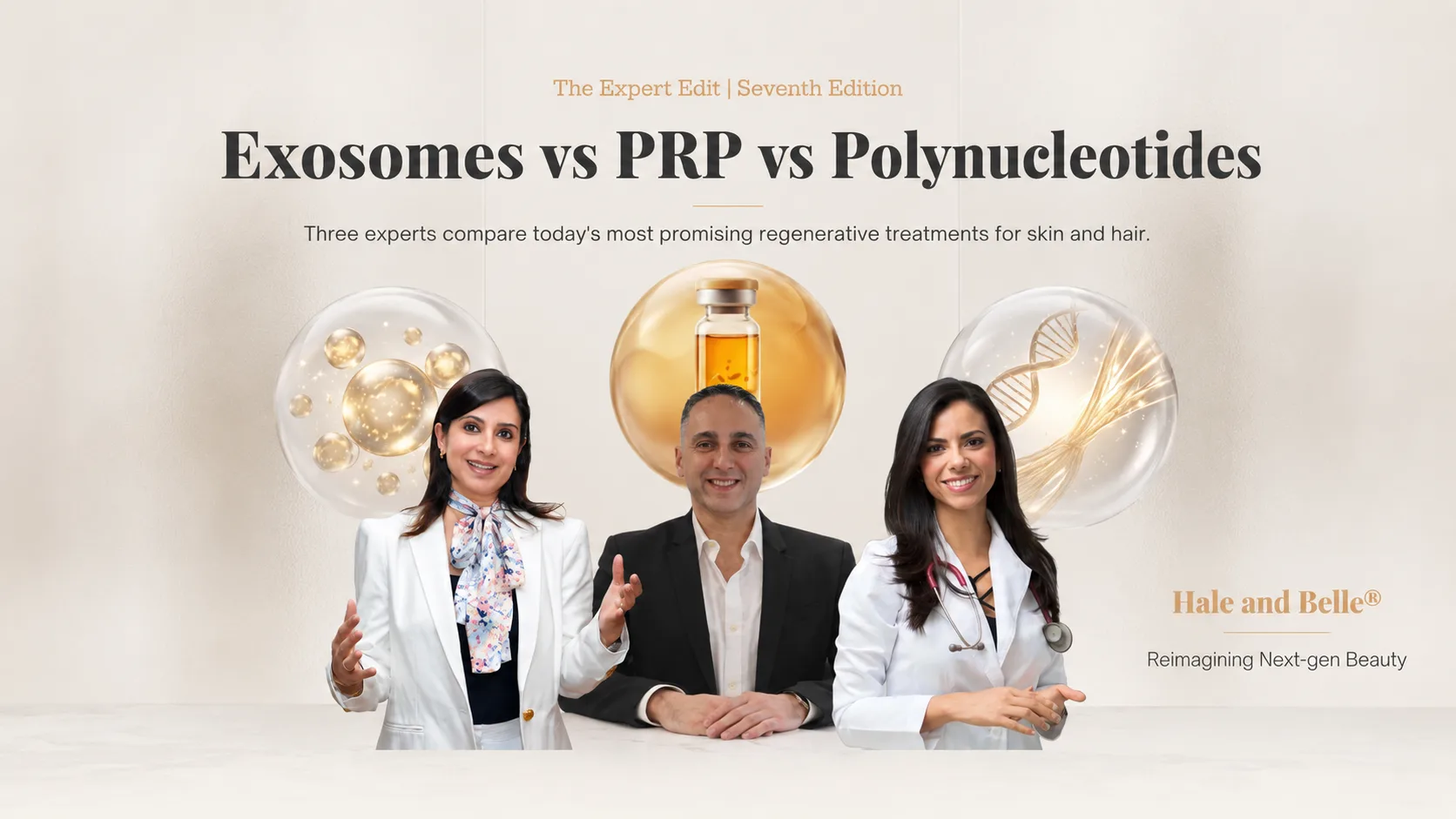
Regenerative aesthetics has moved well past collagen creams and one-size-fits-all facials. Today, three treatments dominate the conversation — PRP vs polynucleotides vs exosomes — each working through a distinct biological pathway to help skin and hair repair themselves. We asked three leading experts to explain what separates them, what the science actually shows, and how to figure out which one, if any, belongs in your routine.
The Expert Edit, Edition 07 | By Hale and Belle® Editorial Team
Regenerative treatments have transformed the conversation in dermatology offices and aesthetic clinics. Rather than masking concerns, these treatments work with the body’s natural repair mechanisms, encouraging the skin and hair follicles to repair and regenerate from within.
However, the term “regenerative” has become a catch-all label. People often group three treatments—platelet-rich plasma (PRP), polynucleotides, and exosomes—together. Many discuss them in the same breath, and some clinics even present them as interchangeable alternatives or upgrades. In reality, they work differently and serve distinct purposes.
Each works through a different biological mechanism. Each has a different evidence base. And each is suited to different concerns, timelines, and candidates.
“The three regenerative modalities work through different mechanisms despite often being grouped together, so the comparison depends on what the patient is actually trying to address,” says Dr. Cameron Rokhsar, founder and medical director of the New York Cosmetic Skin & Laser Surgery Center.
We spoke with three experts working at the front lines of regenerative aesthetics to unpack how these treatments really compare — scientifically, clinically, and practically.
What Is PRP (Platelet-Rich Plasma)?
PRP begins with a small sample of the patient’s blood. A centrifuge separates the platelet-rich plasma, which clinicians then inject into the skin or scalp. This concentrated plasma contains a high level of growth factors that stimulate tissue repair, boost collagen production, and enhance blood circulation in the treated area.
Because clinicians prepare PRP entirely from the patient’s own blood, it has an established safety profile and remains one of the most extensively researched regenerative therapies in aesthetic medicine.
“PRP is an autologous concentrate of growth factors and currently has the strongest published evidence for hair restoration and post-procedure recovery,” Dr. Rokhsar explains.
Dr. Olga Gonzalez, founder and medical director of HealthBridge Medical Tourism, agrees that PRP remains the clinical benchmark. “PRP remains the foundation because it uses the patient’s own platelets to release growth factors that stimulate tissue repair. It is well tolerated, has the strongest evidence for skin rejuvenation and hair restoration, and offers the most established clinical track record,” she says. “That said, results vary from person to person, and multiple treatment sessions are often required.“
Best suited for: Hair thinning and androgenetic alopecia, post-procedure healing, general skin rejuvenation, and patients who want a treatment made entirely from their own biological material.
What Are Polynucleotides?
Polynucleotides — which include the widely used PDRN (polydeoxyribonucleotide) family — are fragments of DNA, typically derived from purified salmon or trout sperm cells, that are biocompatible with human tissue. Once injected, they support fibroblast activity, encourage tissue repair, and help the skin hold onto water more effectively.
Unlike PRP, polynucleotides aren’t derived from the patient’s own body, but they’ve built a growing reputation for improving overall skin quality rather than targeting one specific concern.
“Polynucleotides, including the PDRN family, are nucleotide fragments that support fibroblast activity, with growing evidence for improving skin texture and healing,” notes Dr. Rokhsar.
Dr. Gonzalez has increasingly turned to polynucleotides for clients who need more than PRP alone can offer. “Polynucleotides work by promoting hydration and dermal remodeling. I’ve seen encouraging results in clients looking to improve skin texture and overall skin quality, particularly when PRP alone hasn’t achieved the desired outcome,” she says. “However, the evidence remains less robust than it is for PRP.”
Best suited for: Dehydrated or dull skin, early signs of ageing, uneven texture, and post-inflammatory skin repair, including after certain energy-based procedures.
What Are Exosomes?
Exosomes are among the newest and most talked-about additions to the regenerative toolkit — and also the least straightforward to explain. They’re extracellular vesicles: tiny, membrane-bound packages that cells release to communicate with one another. Inside each vesicle is a cargo of proteins, lipids, and signalling RNA that can instruct neighbouring cells to behave differently — including ramping up repair and regeneration.
“Exosomes are extracellular vesicles that carry proteins, lipids, and signalling RNA between cells,” says Dr. Rokhsar. “They have the highest theoretical potential among the three but currently have the least clinical data supporting their use in skin applications. The regulatory framework around exosome-based products is also still evolving.”
Topical vs Injectable Exosomes: Why the Difference Matters
It’s a crucial nuance: not all exosome treatments are the same procedure. Some are delivered topically, applied to the skin after microneedling or laser resurfacing to enhance healing. Others are injectable formulations administered directly into skin or scalp tissue. The two are not interchangeable, and injectable exosome therapies carry a different risk and regulatory profile than topical, post-procedure applications.
What Do Experts Say About Exosomes?
Aesthetician and BioClinic founder Pretti Singh sees exosomes as fundamentally about communication rather than correction. “Many people think exosome therapy is simply another skincare treatment. In reality, exosomes are tiny extracellular vesicles that facilitate cell-to-cell communication, helping support the skin’s natural repair and regeneration processes,” she says. “Rather than delivering an instant cosmetic fix, exosomes work by supporting collagen and elastin production, strengthening the skin barrier, improving hydration, and encouraging healthier skin renewal.”
Dr. Gonzalez sees similar promise, tempered by the same caveat Dr. Rokhsar raises. “Exosomes take a different approach by delivering extracellular vesicles that carry powerful cell-signalling molecules. Early clinical findings are encouraging, particularly for improving skin quality and supporting hair restoration, but manufacturing standards, product quality, and long-term evidence continue to evolve.“
Best suited for: Patients focused on overall skin quality, barrier repair, and enhanced recovery after procedures like microneedling or fractional laser — ideally as part of a broader, personalized plan rather than a standalone fix.
How Exosomes Actually Work on Skin
Singh breaks down the biological cascade in practical terms. In the weeks following treatment, exosomes may help support several processes simultaneously: increased collagen production, improved elastin synthesis, higher hyaluronic acid output, better microcirculation, and the gradual replacement of damaged cells with healthier ones.
The visible results, she says, tend to build gradually. “Over the next two to three months, many clients may begin to notice firmer skin, improved elasticity, smoother texture, better hydration, a brighter complexion, softer fine lines, and improved recovery following acne scars or aesthetic procedures.“
That timeline is a defining feature of regenerative treatments generally — none of the three deliver an overnight transformation, because they’re working on repair processes that take weeks to unfold, not filling in volume or relaxing muscles the way injectables do.
PRP vs Polynucleotides vs Exosomes: Quick Comparison
| Feature | PRP | Polynucleotides | Exosomes |
| Source | Patient’s own blood | Purified DNA fragments (often salmon/trout-derived) | Extracellular vesicles, typically lab-cultured |
| Mechanism | Releases growth factors to trigger repair | Stimulates fibroblasts, boosts hydration | Cell-to-cell signaling, supports collagen/elastin |
| Delivery | Injection | Injection | Injection (clinical) or topical (post-procedure) |
| Strongest evidence for | Hair restoration, post-procedure recovery | Skin texture, hydration, tissue repair | Still emerging; early data on skin quality and hair |
| Clinical maturity | Most established | Growing rapidly | Newest, least standardized |
| Typical candidate | Hair thinning, general rejuvenation | Dull, dehydrated, or textured skin | Overall skin quality, procedure recovery |
| Regulatory status | Well established (autologous) | Established in many markets | Still evolving |
Combining Treatments: Why Practitioners Rarely Use Just One
None of these treatments tends to work in isolation in most clinical settings. Dr. Rokhsar is direct about this: “None of these treatments is a magic bullet. They often deliver the best outcomes when combined with procedures such as fractional laser resurfacing or microneedling that stimulate the skin’s natural healing response.”
Topical exosome formulations, for instance, are frequently applied immediately after microneedling to support the skin’s repair response while the barrier is temporarily more permeable. Polynucleotides are sometimes layered in after PRP hasn’t fully addressed a patient’s texture or hydration concerns. The through-line across all three experts is that regenerative aesthetics increasingly means building a *plan*, not picking a single procedure.
Safety and Regulatory Considerations
PRP’s autologous nature — using the patient’s own blood — gives it the most straightforward safety profile of the three, with a well-documented track record and minimal risk of immune reaction. Polynucleotides, largely derived from purified, non-human DNA sources, are also well established in many markets, though sourcing and purification standards matter.
Exosomes sit in a different category. Because they can be derived from various cell sources and manufactured in different ways, product quality and purity vary significantly between suppliers — and regulatory oversight is still catching up with the science. Both experts flagged this directly: Dr. Rokhsar notes the regulatory framework “is also still evolving,” while Dr. Gonzalez points to “manufacturing standards, product quality, and long-term evidence” as areas still maturing. For anyone considering exosome therapy, this makes the practitioner’s sourcing standards and clinical judgment especially important.
Who Is an Ideal Candidate?
According to Singh, there’s no universal candidate profile — and that’s by design. “Exosome therapy can benefit a wide range of skin types, but no two clients respond in exactly the same way. Factors such as age, skin condition, lifestyle, nutrition, stress levels, sleep quality, and consistency with skincare all influence the final outcome.“
This holds broadly true across all three treatments. A patient with early hair thinning and no other concerns may be a straightforward PRP candidate. Someone with dehydrated, textured skin might respond well to polynucleotides. A patient recovering from a resurfacing procedure who wants to support overall skin quality long-term may be steered toward an exosome-based plan. The right fit depends on assessment, not preference alone.
Choosing the Right Treatment: What Matters Most
Dr. Gonzalez sums up the decision-making process simply: “Matching the level of scientific evidence with realistic client expectations is ultimately more important than choosing the newest technology.“
That means the newest option on the menu isn’t automatically the best one for a given concern. It means asking a practitioner what evidence supports a specific treatment for a specific goal, understanding the realistic timeline for results, and being honest about what a single treatment — or even a single course of treatments — can and can’t achieve.
Singh’s approach at BioClinic reflects this philosophy in practice. “Every treatment begins with a comprehensive skin assessment and a clear understanding of the client’s primary concern. Instead of trying to address every issue at once, we focus on one treatment goal over a three-month period before reassessing the skin and refining the plan.” She adds that in-clinic treatment is only half the equation: “Equally important is a consistent home-care routine. In-clinic treatments and daily skincare work hand in hand, and long-term skin health is built through consistency, personalised care, and regular evaluation—not a single procedure.”
The Future of Regenerative Aesthetics
Looking ahead, all three experts see room for all three treatments to keep evolving — just along different timelines. Dr. Rokhsar predicts PRP will remain the most consistent option in the near term: “Today, PRP has the most consistent clinical evidence and the longest track record. Over the next three to five years, polynucleotides will likely become a standard option for improving skin quality. Exosomes have the greatest future potential if manufacturing standards and regulatory oversight continue to mature.“
Dr. Gonzalez shares a similar outlook on where the science is heading. “Looking ahead, exosomes may have the greatest long-term potential as the science advances. For now, however, PRP remains the most evidence-based regenerative treatment available.“
Key Takeaways
- PRP uses the patient’s own blood-derived growth factors and currently has the strongest clinical evidence, particularly for hair restoration and post-procedure healing.
- Polynucleotides support fibroblast activity and hydration, with growing evidence for improving skin texture, skin quality, and tissue repair.
- Exosomes facilitate cell-to-cell signaling and carry significant theoretical potential. However, the clinical evidence base and manufacturing standardization are still evolving.
- Exosome therapies are not universally non-invasive. Injectable formulations differ from topical applications used after procedures such as microneedling or laser resurfacing.
- These regenerative treatments are frequently combined with microneedling, laser resurfacing, or one another, rather than being used as standalone therapies.
- The most appropriate treatment depends on the patient’s individual concerns, clinical assessment, and the practitioner’s expertise—not on which option is newest or generating the most attention.
Frequently Asked Questions
A: PRP currently has the strongest published evidence for hair restoration. Exosomes show encouraging early results for hair as well, but the evidence base is still developing.
A: Exosome therapies are generally considered promising, but product quality varies by manufacturer, and regulatory standards are still evolving. Choosing a practitioner who sources carefully and can explain their product’s provenance matters significantly.
A: Not always. Topical exosome formulations applied after procedures like microneedling are minimally invasive, but injectable exosome treatments are a separate, more invasive category with different considerations.
A: Yes. All three are frequently paired with procedures such as microneedling or fractional laser resurfacing, and practitioners sometimes layer polynucleotides or exosomes into a plan when PRP alone hasn’t fully addressed a concern.
A: Timelines vary, but most regenerative treatments require several weeks to months to show visible change, since they work by supporting the body’s own repair processes rather than delivering instant volume or correction.
A; PRP currently has the most robust and longest-standing body of clinical evidence among the three.
Takeaway
When comparing Exosomes vs PRP vs Polynucleotides, there is no single “best” regenerative treatment—only the treatment that best addresses a specific concern at the right time under the guidance of a qualified practitioner. PRP remains the benchmark because of its extensive clinical evidence and long-established safety profile. Polynucleotides continue to gain recognition for improving skin quality and supporting tissue repair, while exosomes represent one of the most promising frontiers in regenerative aesthetics, valued for their cell-signalling potential and versatility as research and manufacturing standards continue to evolve.
Ultimately, the Exosomes vs PRP vs Polynucleotides debate isn’t about choosing the latest trend. What unites all three, according to the experts we spoke with, is a move away from one-size-fits-all treatments toward highly personalized care. The right choice depends on your skin or hair concerns, treatment goals, and a comprehensive assessment by a qualified practitioner who can recommend the most appropriate approach.
Explore more in The Expert Edit only on Hale and Belle® —where beauty meets authority, and real solutions start with real experts.
Want the latest scoop, exclusive deals, and skincare secrets? Follow us on WhatsApp and never miss a glow-up moment!